Route details, maps, pubs, features, local history and folklore for a wide variety of walks focusing primarily on Norfolk and Suffolk

Walks
Showing posts sorted by date for query Blackpool. Sort by relevance Show all posts

Thursday, 19 December 2019

South West Coast Path - Dartmouth to Torcross

Dartmouth

A 9 mile walk along the South West Coast Path between Dartmouth and Torcross.

This section of the walk starts at the deep water port of Dartmouth which is famed for where the second and third crusades departed in the 12th century. Across the River Dart is Kingswear, and down the estuary is Dartmouth Castle, built in the 15th Century. Passing the castle, the path heads round the coast and up to the village of Stoke Fleming, then meanders across the hills and lanes either side of the main Dartmouth road until it meets Strete. Here it descends down to Slapton Sands, which despite its name, is a shingle beach on one side and Slapton Ley, a natural freshwater lagoon, on the other. A simple walk with a few hills to negotiate and a bus service that links the two ends of the walk.

Dartmouth to Torcross Walk - Essential Information

Walk Statistics:

  • Start location: Dartmouth 
  • End location: Torcross 
  • Distance:   miles (  km)
  • Total Gain:   ft (  metre)
  • Total Descent:   ft (  metre)
  • Min Height:   ft (  metre)
  • Max Height:   ft (  metre)
  • Walk Time:  
  • Walk type: Linear
  • Walk Grade: Moderate - some steep hills but nothing too arduous
  • Terrain:

Maps:

The following maps and services can assist in navigating this route. There are links to printed maps and links to downloadable GPX route data for importing into navigational software and apps.


Accommodation:

Parklands Caravan and Camping SiteView in OS Map | View in Google Map
Website
Description
Parklands Caravan and Camping Site, Churchstow nr Kingsbridge. Small friendly site on the A381 about 1 mile from Churchstow village

Transport:

Details of public transport that is required for the walk

Traveline - Bus Service
Service Details
3 - At the time of walking the Stagecoach 3 service operated between Dartmouth and Torcross. It is advised to use the Traveline website for the latest services and operators
Timetable

Route Verification Details

  • Date of Walk: 2011-06-20
  • Walk Time: 12:30 to 16:30
  • Walkers: Griffmonster, Kat
  • Weather Conditions: Very wet day with thick mist and intermittent heavy rain

Walk Notes

This was the fourth day of a 8 day expedition walking the South West Coast Path from Exmouth to Plymouth. The day started with moving camp from Upton Park at Brixham through to Parklands at Churchstow. The weather was very misty - a sort of fog that lingered despite the constant breezes. It was clear there would be no immediate let-up so we un-pitched a very wet tent then drove via Totness to Churchstow and re-pitched an hour later.

The village of Churchstow was a little further from the campsite than we had anticipated resulting in a 1 mile walk along busy twisting roads with no pavements or verge. Unhindered, and with the tent still to be sorted internally, we ventured down to the village in order to catch the 10:47 bus to Dartmouth where we could begin the days walk. The bus stop was located opposite the church and although there was 10 minutes to spare on our arrival, it wasn't until 11:20 that the double decker pulled in. The driver blamed the lateness on an overheating engine which was causing a loud alarm to sound from the driver console. He assured us that he had been instructed by the company engineer that he had to keep the engine running in order to prevent seizure! He waited a further 5 minutes until the siren ceased then continued the journey with the warning of 'we may not get there'.

Beyond Kingsbridge, the road to Dartmouth becomes narrow, with just enough room to get two cars past each other. When a double decker bus arrives, traffic in the opposite direction has to find means of pulling over to allow it past. There were numerous occasions on the twisty road where arrogant drivers refused to budge and expected the bus to attempt to back up which was really not practical. When these encounters occurred queues of traffic built up in either direction until the hapless motorist reconciled themselves to the fact that they had to give way. It appeared to be fairly obvious that the majority of these motorists were not locals and the bus driver seemed very patient with their constant harassment. My own criticism would be that the buses must take some blame as I am certain if they employed a fleet the smaller buses every half hour instead of double deckers each hour this would alleviate many of the problems.

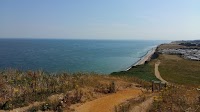
Consequently, after these delays, we arrived at Dartmouth well over half an hour late which only left a maximum of 6 hours to complete the walk and get the last bus from Torcross. With the weather being so miserable there was no inspiration to hang around so we immediately headed off only briefly stopping at Dartmouth Castle where a packed lunch was hastily downed before pressing onwards. There were highlights to the walk, despite the weather: we managed to get a glimpse of Blackpool sands through the gloom which was our first view of the sea since Dartmouth; and there was a memorable challenging hill in front of Landcombe Cove where the path descends steeply down a grassy hillside to a stream at the bottom. With the wet weather this posed a few problems and although there were a few makeshift steps worn into the hill, it was very slippery. Once across the stream the path ascended another hill which was not quite as steep The sheep grazing besides the stream looked on anonymously though I am sure some were quietly sniggering to themselves as they anticipated one or both of us ending up on our backside on the slippery slopes.

Due to the late start we unfortunately had to forgo popping into the Green Dragon at Stoke Fleming (though I include a little history of this establishment in the blog). By the time we got to Strete we had made good progress and decided there was enough time to have a quick drink in the Kings Head. However, on arrival we found that it had closed for the afternoon which was a disappointment. We had to content ourselves with a soft drink from the local post office when a local ale probably would have cheered our soggy spirits. From Strete the path heads down to Slapton Sands where the land flattens and opens up in front of Slapton Ley. At this point the rain really started coming down and with a brisk wind blowing against us it became a dismal end to the walk, heads down the trudging onwards through the open landscape at the mercy of the elements. As we approached Torcross village the late 16:08 bus from Dartmouth made its way along the straight from behind and I flagged it down to get us out of the wet day. Thankfully the bus stopped for us otherwise it would have been over an hours wait for the next bus and in this sort of weather it wasn't a prospect to contemplate. The bus driver obligingly dropped us at A379/A381 cross roads, only half a mile from the campsite. A disappointing day but it kept us on track to completing the full walk between Exmouth and Plymouth. That evening we watched the misty fog from the tent and at one point we could not see the tree across the other side of the pitch, a distance of probably no more than 20 yards. So we ended the day with a glass of wine on this typical English Summer evening - June, foggy, cold. Despite this our spirits were not dampened, it is all part of walking and camping. Love it really.

Slapton Sands
Slapton Sands

Directions

The path is fully detailed in the The South West Coast Path: Falmouth to Exmouth National Trail Guide.

From Dartmouth take the riverside road out to Dartmouth Castle from where the Coast Path is waymarked with the National Trail acorns.

Dartmouth CastleMemorial at Torcross commemorating the lives lost in the D-Day landings
On the left Dartmouth Castle; On the right Memorial at Torcross commemorating the lives lost in the D-Day landings

Pubs

Green Dragon, Stoke Fleming View in OS Map | View in Google Map

Image of pub
Address
Green Dragon, Stoke Fleming
Website

The name of this 12th century hostelry is said to have come from a Welsh knight returning from the crusades. The building was originally owned by the Lords of the manner who leased it out. The earliest recorded landlord is from 1607 who was registered as a 'Licensed Tippler' Local legend states that there was once an old Cuddy on the premises, which is a cabin type boat and this was made use of by King George VI when he was Prince of Wales. The building has a traditional stone floors, large fireplaces, wooden beams and it is rumoured that there is a secret tunnel, no doubt from the days when smuggling was rife in these parts. Of course, an old building with such a history as this has to have a ghost, or so some say though details are not forthcoming.

Review

Unfortunately we could not pay this pub a visit due to time restrictions. It appears to be an interesting hostelry and I would recommend anyone walking this section to take time out and check it out.

Blackpool Sands
Blackpool Sands

Features

Bayard’s Cove FortView in OS Map | View in Google Map

As the South West Coast path heads along the riverside out of Dartmouth it comes to Bayard’s Cove Fort which gives access to the road above. This fort was built in the early 16th century by the townspeople of Dartmouth to protect the town quay. The significance of its strategic position is best appreciated from the sea: it controls the narrowest point of the channel at the entrance to Dartmouth harbour. This is now an English Heritage site.

References

Dartmouth CastleView in OS Map | View in Google Map

Dartmouth Castle, together with Kingswear Castle on the opposite side of the River Dart, were built to act as a guard for the estuary. The structure is built on a rocky promontory close to the water's edge adjacent to St Petroc's church. A small fortalice was constructed in 1388 but the oldest part of the present structure is the Guntower which was built between 1481 and 1495 with additions in the 16th and 17th centuries. The civil war saw the castle taken by the Royalists who added an earthwork above at Gallants Bower. After 3 years it was attacked and taken by the parliamentarians in 1646. The Castle continued to be used as a fort right up until the nineteenth century and it was also put to use throughout the first and second world wars.

Today the Castle is owned by English Heritage and open to the public and hosts special events throughout the summer months.

References

Operation Tiger - SlaptonView in OS Map | View in Google Map

Slapton is probably most infamous for its part in World War II when it hosted Operation Tiger, a full blown exercise in preparation for the D-Day invasion of Normandy in 1944. Slapton was chosen due to its similarity to Utah Beach which was a gravel beach followed by a strip of land and then a lake. 3000 local residents were evacuated for the exercise to take place and nine large tank landing ships and 30,000 troops were involved in the mock invasion which started on 22 April 1943 and lasted 8 days.

The operation was far from smooth in its undertaking. On their approach to Slapton the convoy of ships was spotted by a fleet of German U-boats and attacked. Two ships caught fire with one sinking and a total of 638 soldiers lost their lives, many drowning whilst waiting to be rescued. Even on landing mistakes were made and 308 men died from friendly fire.

Despite the setbacks, lessons were learnt and although nearly called off, the D-Day landings went ahead as scheduled. Today a memorial and a Sherman Tank stand as testament to those who lost their lives in the exercise.

References
Tank Memorial at Torcross commemorating the lives lost in the D-Day landings

Gallery

Below are a selection of images taken from from the photo album for this walk. Feel free to browse through these or click on an image to view a larger version in the Gallery.

Summary of Document Changes

Last Updated: 2021-12-07

2011-07-10 : Initial publication
2018-01-05 : General site maintenance
2019-01-25 : General site maintenance
2019-12-19 : General site maintenance
2021-03-17 : Update website improvements and removal of ViewRanger reliance
2021-12-01 : Removal of ViewRanger links due to its imminent demise

Tuesday, 17 December 2019

South West Coast Path - Bucks Cross to Hartland

Blockchurch rock

An 16 mile walk along the South West Coast Path between Bucks Cross and Hartland

An easy start to a walk through the tree covered cliff-tops makes a pleasant ramble through to Clovelly. There follows a couple of challenging valleys to cross and then broad open meadows for more easy walking through to Hartland Point. At this stage the coast turns South to reveal a coastline that can only be described as truly spectacular.

South West Coast Path - Bucks Cross to Hartland - Essential Information

Walk Statistics:

  • Start location: Bucks Cross 
  • End location: Hartland 
  • Distance:   miles (  km)
  • Total Gain:   ft (  metre)
  • Total Descent:   ft (  metre)
  • Min Height:   ft (  metre)
  • Max Height:   ft (  metre)
  • Walk Time:  
  • Walk type: Linear
  • Walk Grade: moderate with some challenging sections
  • Terrain: Easy cliff top paths but some changeling valleys especially around Hartland Point

Maps:

The following maps and services can assist in navigating this route. There are links to printed maps and links to downloadable GPX route data for importing into navigational software and apps.


Accommodation:

Upper Lynstone Camping and Caravan ParkView in OS Map | View in Google Map
Website
Description
A popular family run campsite close to Bude and with easy access to the South West Coast Path

Transport:

Details of public transport that is required for the walk

Stagecoach - Bus Service
Service Details
319 - Stagecoach 319 Serrvice linking Bude and Hartland and Barnstaple
Timetable

Route Verification Details

  • Date of Walk: 2017-07-27
  • Walk Time: 07:30 to 16:30
  • Walkers: Griffmonster, Kat
  • Weather Conditions: Blue skies, sunshine, warm

Walk Notes

Due to the limitations of public transport, this walk was undertaken using westerly direction of travel. This is somewhat easier than the previous sections of the Coast Path up from Port Isaac. Don't get me wrong, there are challenges on this section but in comparison to the previous Hartland to Bude hike, this really was a walk in the park.

The walk starts at Bucks Cross which is not exactly on the coast path but offers easy access through the Bideford Bay holiday park. This starting point is never detailed on most guides or itineraries and was chosen as a suitable half way point between Hartland and Westward Ho!. The 319 bus service links Hartland, Clovelly, Bucks Cross and Bideford and provides a means of transport along this part of the coast although the frequency is not particularly great. In this instance Hartland village was chosen as the place to leave the car where there is a small free car park at the centre of the village. The bus stop is not far from the car park, situated on North Road by the sharp turn in the road. The first bus out in the morning is just after 7 on a weekday, a little later on Saturday and judging by the number of waiting passengers was a valuable link to Bideford. We arrived in plenty of time but it was soon evident that the bus was late. It is always late was the remark made by a large ageing man waiting with us. He huffed and puffed but not through disgruntled discontentment at the lateness of the bus but the fact that walking was a major challenge for him, his later years leaving him gasping for breath when any physical exertion was required. As such the bus was a lifeline for him. He was a cheerful chap where most sentences that issued from his mouth were either preceded or terminated with a joke or humorous remark. He had been a bus driver in London for most of his life. He knew buses ran late and didn't particularly care. He knew it would turn up. Eventually. He had all the confidence in the world of that fact. Personal experience of some of the national bus companies certainly did not instil the same confidence in myself. I told you, he laughed as the bus eventually arrived around the corner and he stepped onto the bus and chatted with the driver as if he was an old lifelong friend.

One would expect the bus to have headed along the coast road to Bideford but this is not the case. It migrates around various villages and thankfully, having the OS map at hand, it provided the necessary means of determination of when Bucks Cross was imminent. The village is just beyond the fantastically named village of Woolfardisworthy where the lane meets the A39 with the stop being on the main road. The name of Woodfardisworthy would sit right in place in a Douglas Adams novel, maybe an unmentioned assistant to the Magrathean planet designer Slartibartfast.

From the bus stop, a wander down the road into the holiday park where there is a footpath close to the reception that connects to the Coast Path. The walking is fairly easy to start with, nothing too challenging with the path leading through to a rough asphalt lane that leads around the contours of the hills. This is known as the Hobby Drive, a name that is purportedly derived from the fact that the instigator of this road, the 19th century MP and former Sheriff of Devon, Sir James Hamlyn Williams, constructed it during his retirement as a hobby. An additional 833 yards was added to the trail in 1901 which is commemorated in a stone bench with the words

THE NEW PORTION OF ROAD MEASURING 833 YARDS WAS ADDED TO THE HOBBY BY FREDERICK AND CHRISTINE HAMLYN IN THE YEAR OF OUR LORD GOD 1901.

The Hobby Drives curves around the contours where two streams cascade down the cliffside. Below is an area known as the Devils Kitchen and the location of the main feature to this article, the folklore of the cannibal John Gregg. As the Drive gets back to the coast one is greeted with glimpses of the unique village of Clovelly far down below at the foot of the cliffs with its pier jutting out into the sea. This is somewhat of a tourist haven and is certainly a place one could consider as the stereotypical picture postcard Devon coastal village that has not changed since Elizabethan times. Even today vehicular access down its steep cobbled street is prohibited and the only method to transport goods to and from the village is by donkey or the sea. The village is worthy of a visit, there is no doubt about that. However one does need to pay to enter. There is a car park where the official reception building is located and where one can purchase a £5 ticket to view the village. As a coast walker there is nothing to stop the rambler from just descending down into the village without even noticing the reception. However, beware, for anyone caught without a legitimate ticket faces being banished from the place. For this walk we passed it by. Another day maybe when more time would provide the moneys worth.

There is some more easy walking across the meadows and woodland that fronts Clovelly Court, a privately owned old manor house which allows public access to its gardens. The path then makes a steady descent down through the wooded valley sides to Mouthmill, emerging close to the beach. A stream cascades down the valley and there are a few disused stone buildings, the remains of old lime kilns. On the beach one can view Blackchurch Rock where rock strata surge from the sea to present two arches. A better view can be had from above the valley. There is a strenuous climb out of the valley which is the first real challenge of the day. The is a brief easy saunter across the cliff-tops before a descent at Windbury Head. Once again, in this direction the descent is steady but the ascent out of the valley is somewhat more challenging.

In the fields beyond Windbury Head, overlooking Beckland Bay, almost hidden in the vegetation along the boundary is a memorial plate commemorating the crash of a WWII Wellington Bomber. The accident happened on April 13, 1942 with the plane was on a non operational flight to Cornwall when it crashed into the cliff in poor visibility, killing all on board. Part of the Wellington's engine were eventually recovered in 1986 and they are now on display in the Hartland Quay museum.

At this point the radar station at Titchberry Cliff comes into view; a white golf ball on a broad stick. Isn't it strange how we always describe such installations as golf balls, yet never remark at the similarity of a golf ball to a radar station? The radar station is some way off and the broad grassy meadows on the gentle sloping cliff-tops provide a worthwhile place to stop and have a picnic. On a lot of day hikes, it is difficult to find a convenient place to stop for a rest and refreshment and on numerous occasions styles have been employed as benches in the absence of a better place to sit and eat ones packed sandwiches. Here, with acres of grassy meadow it was well worth the occasion to race to the centre of the field and plot oneself on the ground amid the grasses and daises and buttercups. This really is living something out of the Famous Five stories and although a Cornish pasty and Mars bars is not quite cucumber sandwiches and lashings of ginger beer, the location nonetheless allows one to enthuse in the Enid Blyton spirit of the occasion and lay back and look at fluffy clouds and listen to the distant sounds of the sea and birdsong.

As one approaches the ominous radar station it becomes blatantly obvious that there must be something special ahead due to the ever increasing number of walkers. Not the sort of walkers who look like dedicated hikers but more the casual attire walker, the Sunday stroller and the dog walker and the cat walker. Cat walker! Yes, cat walker. One has to look twice when one passes a couple where the young lady clenches a lead and on the end of the lead is a pussy cat. A pussy cat! A sort of Siamese type pussy cat leading the way. A cat I tell you. A domestic feline perambulating the South West Coast Path. That is a first if ever I seen one.

The secret of the source of all these people soon comes into view. There is a car park with easy access to Hartland Point and its distinctive lighthouse that sits at the foot of the cliffs. A wooden shack type cafe sits at the edge of the car park. The Point @ Hartland, or so it is named, offers wooden benches to sit at and parasols to bask in some shade. It is busy with people eating. Paninis, Bacon Rolls, all the usual snack fare. We negotiate the vending of a can of ice cold drink and park ourselves on a vacant bench. The couple return with their cat. A cat I tell you. It is blatantly obvious it is a cat now. A cat on a lead. They place it on the table. The cat looks bemused. It is not comfortable sitting on the table. It jumps down and hides in the shade. A cat. A cat on a lead I tell you.

There is then a pleasant stroll to Hartland Point where the lighthouse sits on the rocks below and makes a compelling photographic subject. It is an iconic sight although no longer used for the purposed it was designed. In 2015 Trinity House considered it surplus to requirements and sold it. It certainly attracts the visitors as does the scenery at the point where the coast changes from its westward direction to a southerly direction with some dramatic scenery ahead. Of course dramatic scenery does mean challenging landscape and sure enough there are some strenuous climbs ahead. There is an initial steep descent followed by a climb with a waterfall to view at the bottom. There is then another steep climb up Blegberry Cliff followed by an easier descent and climb which brings one to the final valley at Blackpool Mill.

There is a choice at Blackpool Mill. One can continue across Warren Cliff and then take the road into Hartland. However, as an alternative to avoid encounters with traffic to Hartland Quay there is a footpath identified by a waymarker above Blackpool Mill which points inland. The Hartland Quay road is not heavily used but it is a narrow lane and there is a significant amount of traffic especially during the holiday season and weekends forcing the walker to seek refuge at the side of the road. One notices that many cars in this area have nearside scuffs, dents and damage caused by negotiating oncoming vehicles on such narrow lanes with high stone borders. The alternative route emerges on the much quieter back road which then leads down by Hartland Abbey leaving about a mile along the Hartland Quay road.

Rock formations at Damehole Point

Directions

The South West Coast Path is clearly marked with the usual acorn markers of a national trail

Although the bus at the Bucks Cross stop on the main A39. Proceed westwards along the road to the main entrance into the Bideford Bay Holiday Park. Continue down the western perimeter road ignoring al turnoffs. The road passes a wooded area on the left. As the road swings round to the right take the left to a parking area and reception. On the left there is a footpath through the trees which leads onto the Coast Path which is a short walk, no more than 150yds.

The coast path leads around a wooded area. It can be confusing at the far end where the path appears to lead along the field boundary. Do not take this, but proceed into the woods. The path then becomes clear again leading one through the woods, then following the boundary up to the Hobby Drive, a rough metalled track which provides easy walking.

At Clovelly continue on the road and the Coast Path is found by take the right at the junction then immediately after take the path on the left through the gate. The rest of the path is well way marked through to Hartland Quay.

There are a couple of options in returning to Hartland village. One can either walk through to the Quay Hotel and then take the road through to the village which is just over 2 miles in length. This is no more than a country lane but is well used by sightseers and guests heading down to the Quay. An alternative is to take the footpath just before the Coast Path descends into Blackpool Mill which is waymarked for Hartland. This leads across the fields to little used the top road. Follow this to a junction which is signposted for Hartland Stoke and turn right to follow the road down to the Hartland road at the abbey. this still entails a mile of walking along the busier road.

Clovelly
Clovelly

Pubs

Kings Arms, Hartland View in OS Map | View in Google Map

Image of pub
Address
Fore Street, Hartland
Website

A former coaching inn stand at the centre of Hartland village. Garden with a view, home cooked food, Sunday lunches and a range of ales including the locally brewed Forge Ales.

Review

This did seem very much a locals pub with a group of men and women huddled around the bar. Even so, it was friendly enough and good to discover a draught from the local Forge Brewery on offer here. This ale went down a treat sitting in the garden and admiring the view as the storm clouds closed in.

Clovelly Court
Clovelly Court

Features

The History of John GreggView in OS Map | View in Google Map

A legend that appears to pervade many books and websites that is pertinent to the area around Clovelly, is that of the cannibalistic family of John Gregg. The story tells of a misfit who hailed from an unnamed place some 9 miles east of Exeter. On reaching adulthood, he quit his home village, taking with him an unnamed woman, to live a solitary life in a cave on the coast of North Devon, reputedly close to Clovelly and locally said to be the coastal area known as The Devils kitchen.

The tale continues to relate how the couple went on to have many children and grandchildren and had no contact with the outside world, living in an incestuous existence for over 25 years. They survived by robbing and murdering travellers, carrying their booty and the bodies of their victims back to the cave where they would nourish on the flesh. So great was their crimes it was thought that their victims had numbered in the thousands and included poor souls sent in search of those who had become their prey.

Their downfall came when a couple returning from a local fair were set upon by the Gregg tribe. They killed the woman but the man fought for his life until a group of some 30 fair goers arrived and frightened off the attackers. The Mayor of Exeter was informed and he petitioned the king of England. Such was the reputation that the king sent an army of 400 men and a pack of bloodhounds to search for the villainous Gregg family. They eventually found the cave and witnessed the horrific sight of dismembered legs and arms of their victims strewn across the floor of the lair. The whole family, man women, sons and daughter and grandchildren, were taken to Plymouth where, without trial they were executed by being burnt in three large fires.

For those who want to read the full story, whose full title is The History of John Gregg, and his Family of Robbers and Murderers, it can be found in its original printed form on the National Library of Scotland website. At only 8 pages in length it provides a simple yet absorbing and compelling piece of folklore.

Most folklore is rooted in some distant factual account and embroidered and enhanced over the centuries. However this particular tale is subject to a little more ridicule with many indications that it is nothing more than a piece of total fiction. The account was first published in what was commonly known as a Chap-book in the late 18th century. These small booklets or pamphlets were produced as a form of entertainment during the 17th and 18th century and offered an affordable form of literature, news and reference to the working classes. This obviously assisted in the increase of literacy across the nation that was seen during these years. Subject matter varied from history through to ballads, folk tales such as Jack the Giant Killer to classic texts, with fiction and non fiction rubbing shoulder to shoulder and no specific reference as to the source. The books were distributed across rural Britain by Chapmen, who would use door to door methods as well as local fairs and markets to promote their goods. The name Chapman was derived from the old English word céapmann which had the meaning of a dealer or seller and from which the English surname originated.

It is difficult to determine the history of this specific story prior to the published account in the chapbook and there is nothing to indicate whether the chapbook intended this as a gory piece of fiction or an account of an historic event. The story was said to have taken place in the mid 18th century, the date of 1740 being provided. What is interesting and revealing is that the story is identical, almost word for word, to a similar tale which itself was published during 1775 in the The Newgate Calendar, another periodical chapbook, itself based in London. This tale used the central character of Sawney Beane who allegedly inhabited a coastal cave in Bennane Head on the Firth of Forth in Scotland. Apart from these details the rest of the story is exactly the same including the number of alleged victims, assistance from the King and the capture and the execution of the accused. There is much debate over the existence of Sawney Beane but it is generally thought this is no more than a piece fiction with little or no connection to reality and there never was a real life character by the name as Sawney Beane.

The account of Sawney Beane can be traced back further to Charles Johnson's A general and true history of the lives and actions of the most famous highwaymen, murderers, street-robbers. Johnson was a pseudonym for Daniel Defoe and some have speculated that as it is known that Defoe visited north Devon, that he was the source of both stories although he does not include the Devon version in this specific book.

There have also been some suggestions that the Sawney Beane story was published merely as a derogatory portrayal the Scots as a race of barbarous and villainous characters. The story was set in the times of the Jacobite risings which culminated in the Battle of Culloden in 1746 when there was much animosity towards Scots which is seen in the English press of the day where articles regularly used Scots as a source of ridicule, parody and mockery. The fact the tale appears in a London based publication does suggest that this may well be the case. Even the name Sawney was a derogatory term for a Scotsman, with the common meaning of a fool which was applied to Scots at the time.

It is also interesting to note the library copy of the John Gregg tale, as linked above, was published in Glasgow in 1789. Could this have been a tit-for-tat reprisal by copying the Newgate Calendar story but setting it in Devon as a way of portraying Englishmen in a similar light? It is notable that the place name is spelt Clovaley which does not appear to have been used by other publications during this period, the usual spelling of Clovelly being retained through to modern times.

It is debatable whether the tale is even commonly known around the Clovelly area. The story does come up in some 20th/21st century paranormal books but this may just have been grasping at stories to include in the publication. Some publications relate that it was a smugglers tale used to prevent prying eyes from viewing their activities. This coastline was undoubtedly used for smuggling but there is little evidence, thus far found, that the story was being used in these parts.

It is also notable that any searching for the names of either John Gregg or Seawney Bean appearing in publication of the 18th century and beyond results in nothing other than reiterations of the account from the original chapbooks. One would have thought that the burning of an entire family of three generations in Plymouth would have some kind of historical reference, yet nothing has thus far been found. Therefore in conclusion, this is nothing more than a piece of gory folklore which has attached itself to the North Devon coast but there is little to establish it has any basis in historical fact.

There is no other reference to this tale, which was dais to have taken place in 1740. The most telling of all references is the fact that this is almost word for word the same as an account of a Scottish History of Sawney Beane

References
Hartland Point lighthouse

Gallery

Below are a selection of images taken from from the photo album for this walk. Feel free to browse through these or click on an image to view a larger version in the Gallery.

Summary of Document Changes

Last Updated: 2021-12-07

2018-05-22 : Original publication
2019-12-17 : general maintenance updates
2021-03-17 : Update website improvements and removal of ViewRanger reliance
2021-12-01 : Removal of ViewRanger links due to its imminent demise

Indexes and Info

East Suffolk PRoW Access

The Public Rights of Way (PRoW) within the Suffolk Coastal area between Aldeburgh and Southwold are subject to being blocked up and diverted due to the extensive industrial projects that are currently taking place in the area including the Sizewell C development and various wind farm projects. A PRoW Access page has been written to detail known issues in the area

Walk Summaries

Latest walk summaries are basic information sheets for walks that have yet to be fully documented. These provide links to maps, public transport and walks stats, although detailed notes and features are not included.

Latest Walk Summaries

Featured Walk

In Search of Sizewell Chapel

A 10 mile walk following the southern side of the parish boundary of Leiston in Suffolk This walk follows the route of a 17th century peramb...

What is GPX

All you need to know about GPX, electronic mapping and how to use modern apps and mobile devices as navigation devices

Popular Walks

Maps

Diary of a Suffolk Common

The ramblings and musing of the Griffmonster