Route details, maps, pubs, features, local history and folklore for a wide variety of walks focusing primarily on Norfolk and Suffolk

Walks
Showing posts sorted by relevance for query Blakeney. Sort by date Show all posts

Wednesday, 18 December 2019

Norfolk Coast Path between Blakeney and Cley - Latest Developments

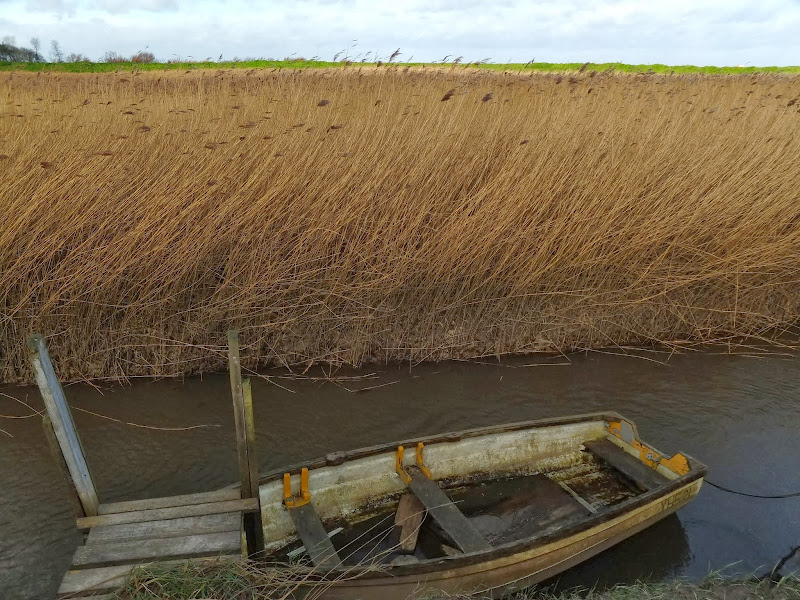
Repaired defence bank close to Blakeney

The future of the 2.5 mile walk along the sea defences between Blakeney and Cley

The December 2013 Storm Surge caused major damage to the sea defences along the Norfolk Coast Path that encompasses the Blakeney Freshes. Work is currently being carried out to repair the breaches, however the long term future of both the Freshes and the coast path at this point is uncertain.

Cley to Blakeney Norfolk Coast Path Walk - Essential Information

Walk Statistics:

  • Start location: Cley 
  • End location: Blakeney 
  • Distance:   miles (  km)
  • Total Gain:   ft (  metre)
  • Total Descent:   ft (  metre)
  • Min Height:   ft (  metre)
  • Max Height:   ft (  metre)
  • Walk Time:  
  • Walk type: Linear
  • Walk Grade: Easy
  • Terrain: Footpath along flood defences throughout

Maps:

The following maps and services can assist in navigating this route. There are links to printed maps and links to downloadable GPX route data for importing into navigational software and apps.


Accommodation:

Galley Hill Campsite, BlakeneyView in OS Map | View in Google Map
Website
Description
Set in area of Outstanding Natural Beauty, Galley Hill Farm Campsite welcomes tents, trailer tents & small campervans. A quiet site located one mile from Blakeney quay. Toilets & shower facilities.

Transport:

Details of public transport that is required for the walk

Various Operators - Bus Service
Service Details
Coasthopper CH1, CH2, CH3 - Unfortunately, in recent years the highly acclaimed Coasthopper bus service has suffered from subsequent takeovers with a consequent deterioration of the service and continuing doubts upon is viability. Due to its constant changing operators, it is therefore best to use the Traveline website to determine the current timetables and services.
Timetable

Route Verification Details

  • Date of Walk: 2014-08-22
  • Walk Time: 14:30 to 16:30
  • Walkers: Griffmonster, Kat
  • Weather Conditions: Blue skies and sunshine with threatening dark clouds

Walk Notes

The storm surge on 5th/6th December 2013 caused a lot of damage to the area around Cley and Blakeney as evidenced during an earlier walk, detailed at The Aftermath of the 2013 Storm Surge - Blakeney, Cley and Salthouse. Returning during August 2014, it would appear that repair works are in progress although the long term future of both the Blakeney Freshes and the Coast Path around them is uncertain. Currently there are several parts of the flood defence banks that the Coast Path follows that have breaches already repaired, albeit the height of the defence bank is distinctly lower than its previous incarnation. A diversion is currently in place across the marsh as works are being undertaken along the northern side of the defences. There is also a major breach adjacent to Blakeney Quay where the current footpath diverts onto the beach area in front of Blakeney. It is good to see access once again available, especially as reports earlier in the year were implying that the repair work was seriously in doubt due to lack of funding.

The Environment Agency, the authority in charge of the area, offered a July update on the matter which is available atwww.norfolkcoastaonb.org.uk/mediaps/pdfuploads/pd003272.pdf. This details the meetings and responses from the various concerned parties who have a stake in the area. The end of the update concludes with the heading 'What Happens Next' which states:

We believe it is inevitable that the habitats of the Blakeney Freshes are going to change over time in response to sea level rise. However, we want to take all practical steps to secure the existing site features for the short term and then to work with owners and occupiers to encourage new nature conservation interests to evolve.

We have concluded from our investigations that the best and most sustainable approach is to repair the damaged embankment with a profile which has a lower and wider crest and shallower slopes. This will be more resilient to damage during any future surge events than the previous embankment design. We also want to reduce the time that saltwater stands on the marshes and we are looking into improvements to the existing sluices and drainage system.

Our intention now is to make progress quickly in order to have a reasonable defence standard in place before the high tides forecast in the autumn. We are planning to be on site in early August and we will issue fact sheets with more details before we start.

It is pleasing to know that this delightful walk is being reinstated although with the defence bank being lower the risk over over-topping is increased with more frequent flooding expected which may well render the coast path along this section inaccessible at certain times. In the longer term, the reference to 'sea level change' appears to imply that eventually this area will be lost to the sea, with the resulting loss of the present route the coast path takes. This remains to be seen.

Even so, whether the long term results in the loss of the route or whether short term flooding leaves the route inaccessible for short periods of time, there are a few reasonable alternatives that enable the walker to perambulate between the two villages:

  • Follow the A149 road route - The road between Blakeney and Cley has a pavement throughout the distance. Although this presents a safe solution to walking the road, it is nonetheless not the most pleasant of routes as the road tends to be busy particularly during the summer months.
  • Diversion through Wiveton - Walking from Blakeney, this takes a permissive path along the edge of the marsh to Wiveton Hall before heading up to the road and straight across to follow the quiet lanes into Wiveton. Taking the lane across Wiveton bridge will then lead into Cley. There is a lane from the church down into the village which circumvents having to negotiate the congested main road through the village. Altogether this is a most pleasant and rewarding alternative with added features of both Wiveton and Cley churches plus two pubs along the route. The downside is that the permissive path, across National Trust land known as Friary Hills, may not always be open. The route will be detailed on this site in the coming months.
  • Diversion across Wiveton Downs - although not strictly speaking a coast path route, and certainly a little longer than the official route, this nonetheless has some spectacular views of the coast from Wiveton Downs which makes it well worth the effort. The route heads south out of Cley, and then uses quiet lanes, footpaths and the permissive path across the downs and back down to the Coast Path between Blakeney and Morston. Features include a ford across the river Glaven and the Shell museum at Glandford but the best feature are the stunning views when one gets onto the downs. Full details of this route can be found at Inland Walk between Cley and Blakeney.
Footpath diversion along the north side of the Freshes

Directions

Beach walk between Cley and Blakeney

The path leads up the embankment on the westward side of Cley village before leading out across the marshes along the defence banks.

Defence banks reduced in height at Cley

Pubs

Kings Arms, Blakeney View in OS Map | View in Google Map

Image of pub
Address
Westgate Street, Blakeney
Website

The pub is recognisable, when approaching from the coast road heading towards the quay, by the distinct characters spelled out in black on the red pantile roofing declaring 'FH 1760'. The 1760 is a reference to when the roof was replaced, however the reason for initials 'FH' are lost in time although it is thought they may have referred to the then owner. There is also speculation that this was the date that the building first became an Inn but the name of the appears to refer back to earlier times. Many pubs obtained royal names after the restoration of the monarchy in 1660 after a period of Puritan rule. This is also borne out in the royal crest which is displayed on the southern wall of the building.

The interior is decorated with memorabilia of old musical hall stars and movie posters. This highlights the career of the former pub owner, Howard Davies, who had a long career which included working with the Black and White minstrels as well as appearing in acting parts for both television and films. Additional items on display are numerous clocks which reflect Howards lifelong interest in horology. Sadly Mr Davies passed away in 2010, but the pub has been retained within the family and is now managed by his son Nic.

The pub is renowned for its fish and seafood dishes and have a specials board that changes daily. Ale from Greene King plus gravity fed barrels of ale from Woodfordes that sit under cooling jackets behind the bar.

Review

The pub is quite compact but always busy and the bar staff friendly. I have to admit that recent offerings of Woodfordes Wherry have not fulfilled expectations, but the offering from this pub, straight from the barrel, restored some faith in the fine ale. A rewarding and refreshing well kept pint.

Defence works in progress on the northern side of Blakeney Freshes

Features

Blakeney ChapelView in OS Map | View in Google Map

On the northward side of the marshes at the point where the Coast Path turns westwards towards Blakeney is the location of the old Blakeney Chapel. The site is to the north of the River Glaven and is therefore unreachable from the coast path with little to view apart from a information board to point out its whereabouts. Despite its name, Blakeney Chapel is not in the parish of Blakeney but Cley and even its use as a chapel is rather dubious. Old maps depict it as a chapel but there is no documentary or archaeological evidence to support the claim of any religious function with the only clue to its use being a small hearth which it has been suggested could imply was for smelting iron. Its first appearance on a map was in 1586 where the building was depicted but unnamed. By 1769 a map by Cranefields displayed the building as "Eye House" but by 1797 William Faden's map names the building as Chapel ruins, a name which has stuck to the present time. Little of the structure remains apart from the foundations, the original building material probably carried off for reuse in the buildings of Cley and Blakeney. Today the ruins are protected as a scheduled monument although there is no active management. With increasing sea levels and constant erosion with a steady migration southwards of the beachside shingle bank it is thought the ruins will soon be buried and then lost to the sea.

References
Defence bank at Blakeney

Gallery

Below are a selection of images taken from from the photo album for this walk. Feel free to browse through these or click on an image to view a larger version in the Gallery.

Summary of Document Changes

Last Updated: 2021-12-07

2014-08-28 : original publication
2019-12-18 : general maintenance updates
2021-03-17 : Update website improvements and removal of ViewRanger reliance
2021-12-01 : Removal of ViewRanger links due to its imminent demise

Saturday, 26 January 2019

Norfolk Coast Path - Cley to Wells-next-the-Sea

Marshes near Blakeney

A 10 mile walk following the Norfolk Coast Path between Cley and Wells-next-the-Sea

An easy walk along the Norfolk Coast Path navigating out across the marshes to Blakeney then along the marsh perimeter to Wells. Blakeney is a worthy stopping point to explore Mariners Hill and the Guildhall and take in the legends of the Blakeney tunnels and the tragic story of the Blakeney Fiddler who is depicted on the village sign.

Wednesday, 18 December 2019

The Aftermath of the 2013 Storm Surge - Blakeney, Cley and Salthouse

Salthouse marshes

A 4 mile beach walk to witness the damage caused by the 2013 Storm Surge along the shingle bank between Cley and Salthouse

The December 2013 Storm Surge caused widespread flooding of the marshes and sea defences along the North Norfolk Coast, resulting in the closure of the Coast path between Blakeney and Cley. It is still possible to walk out to the beach from Cley village via the road where a walk along the shingle will astound those who have walked this section prior to the December storm. The shingle ridge has been levelled, with the excess cast across the marshes.

Cley to Salthouse Beach Walk - Essential Information

Walk Statistics:

  • Start location: Cley 
  • End location: Salthouse 
  • Distance:   miles (  km)
  • Total Gain:   ft (  metre)
  • Total Descent:   ft (  metre)
  • Min Height:   ft (  metre)
  • Max Height:   ft (  metre)
  • Walk Time:  
  • Walk type: Linear
  • Walk Grade: Heavy going across shingle
  • Terrain: Road to and from the beach, shingle beach throughout

Maps:

The following maps and services can assist in navigating this route. There are links to printed maps and links to downloadable GPX route data for importing into navigational software and apps.


Accommodation:

Cambridge House Bed and BreakfastView in OS Map | View in Google Map
Website
Description
Friendly family run sea front guest house next to the Red Lion in Cromer

Transport:

Details of public transport that is required for the walk

Various Operators - Bus Service
Service Details
Coasthopper CH1, CH2, CH3 - Unfortunately, in recent years the highly acclaimed Coasthopper bus service has suffered from subsequent takeovers with a consequent deterioration of the service and continuing doubts upon is viability. Due to its constant changing operators, it is therefore best to use the Traveline website to determine the current timetables and services.
Timetable

Route Verification Details

  • Date of Walk: 2014-02-15
  • Walk Time: 10:30 to 12:30
  • Walkers: Griffmonster, Kat
  • Weather Conditions: Strong to gale force westerly winds with a rapidly moving cl0udscape

Walk Notes

The intention of the days outing was to visit some key areas that had suffered under the December Storm Surge. The intention of this walk was to include Blakeney, Cley and Salthouse, however the path from Blakeney to Cley is closed due to multiple breaches of the sea defences as a result of the surge. The defences from Cley up to the beach have also been breached resulting in the closure of this section of coast path. At least there is a viable alternative at Cley using the beach road, whereas the alternative between Blakeney to Cley is the main Coast Road which is not a recommended walk due to the lack of pavement and the busy nature of this well used coastal route. There is one other alternative route via Wiveton Downs and Glandford. Although this offers some spectacular views it is not really a coast path - this route will be covered in a posting on this site in the near future. Therefore on this particular day of heavy showers and gale force westerly winds Blakeney was reached using the Coasthopper service.

So, in cardinal order of west to east, here is a description of the damage encountered. Firstly Blakeney where the Norfolk Coast Partnership lists the storm surge damage as:

Blakeney Freshes was totally inundated with seawater (c. 157 ha, to a depth of 1 - 2+ metres). There are numerous breaches in the sea wall (total c. 500 metres), some of which are at saltmarsh level so that monthly high water spring tides will put more water onto this area. Water is being evacuated from the Freshes through the one functioning sluice, so the water level has dropped a little in 5 days.

At the time of the surge the media was full of pictures displaying a boat marooned on top of the quay after the floods had receded. This has now been removed and appears to be the same cruiser which languishes in a forlorn state against the sea defence adjacent to the first breach. The rusting hull has several notices taped to it, these are orders for removal. Obviously no-one has claimed the boat. There is no indication of where it came from and it may well have been torn from its mooring and been brought in on the flood tide leaving the owners lost as to its current whereabouts.

A little closer to the harbour is a Wayfarer dinghy sitting atop of the defences and blocking the coast path. This was obviously deposited here by the tide. Not that there is any point to continuing along the coast path with the breach by the cruiser being a full 20 yards in length and beyond that a fence denying access further along the path. Reports from the Environment Agency and Norfolk Council website attest to there being multiple breaches along this path through to Cley. The EA are currently assessing the damage and they have stated that the repair would be both costly and challenging. Therefore the agency is consulting environmental bodies and the people of Blakeney on the future of protecting the Freshes marsh and hence the reinstatement of the coast path. It would be a very sad loss to have this section of coast path permanently closed as it is an excellent example of the landscape that is typical of the Norfolk Coast Path and one which I have personally walked on many occasions and found a real pleasure in doing so.

I do get the impression that the abandonment of the marsh to the sea is something which the residents are firmly against. The marshes and the coast path are the reason for visitors coming to the village. As the landlord of the Kings Head in Blakeney was heard to say whilst we dropped in for a pint, "if there is no coast path or marsh then why would anyone want to visit". It was interesting to listen to this man who experienced the flood first hand. Although he was not specifically speaking with us, he was nonetheless relating the stories to another couple. He depicted the level of the water in the bar then emphasized that the level dropped a full ten inches when the waters first breached the defences and flooded into the marsh.

Moving onto Cley, once again the Norfolk Coast Partnership has listed the details of the damage:

  • Two major breaches in the shingle bank, at Salthouse (400m west of Little Eye) and Pope’s Marsh (east end of Sea Pool).
  • Extensive wash-back of shingle, up to 100m onto marshes.
  • Beach car park covered in shingle, other car parks extensive debris.
  • North Hide washed away, other hides damaged or inaccessible due to boardwalk damage.
  • Extensive stretches of boardwalk damaged.
  • Extensive areas of fencing lost, damaged or buried under shingle.
  • Several bridges damaged or washed away.

Despite starting out on the coast path past Cley windmill, progress is soon hampered by a fence blocking the way with a typed notice to declare the path closed due to breaches caused by the storm surge. In reality much of this has already been repaired and some walkers were seen to have clambered up the defence bank beside the beach road to walk along it. Hopefully this will be officially reopened in the near future as, although the road is not particularly busy, it is nonetheless single track and one has to constantly make way for passing vehicles.

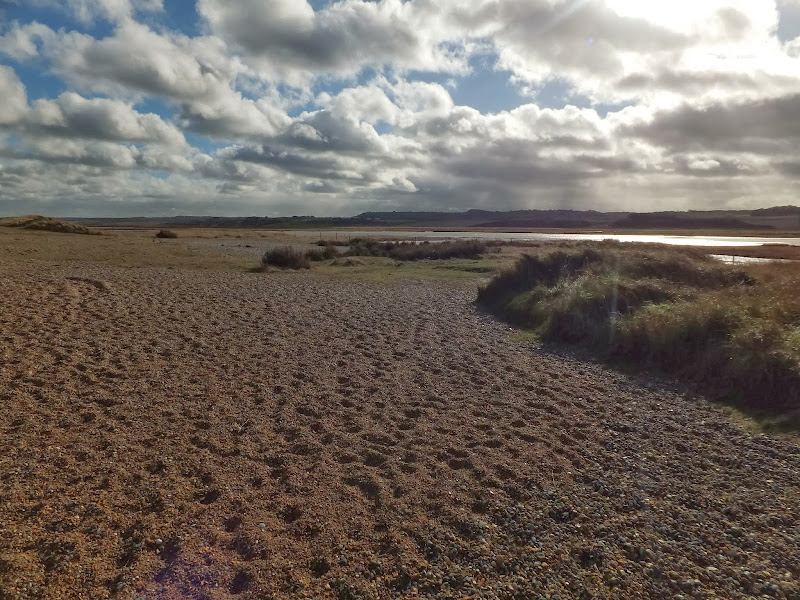
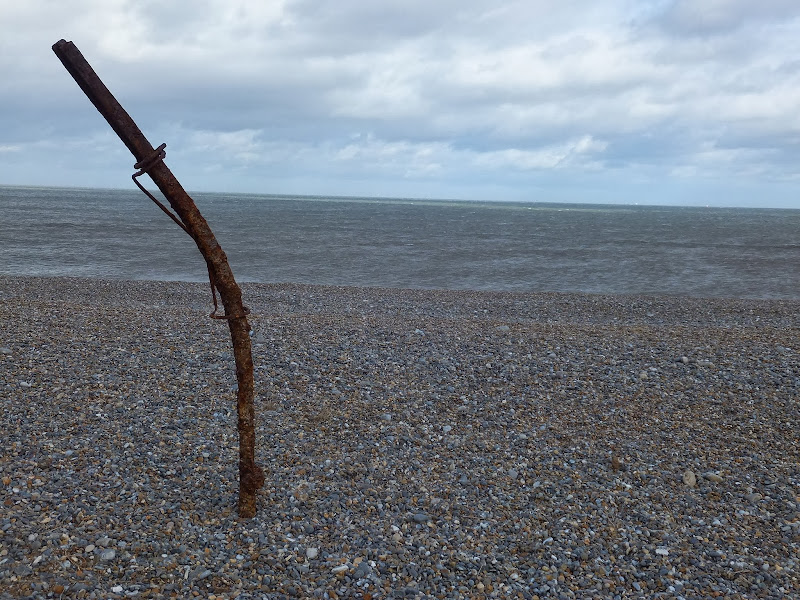
Cley beach gave a sample of the damage along this section of coast. The shingle that typifies this length of the coast path has shifted to such an extent that it was unrecognisable. The Cley beach car park was covered in deep shingle. The square shelter where I have taken rests on its seats on previous occasions was half buried in shingle. The old WWII pillbox is nearly underneath the shingle. Shingle has been swept across the marsh. The shingle ridge that defended the marshes is now flattened all the way through to Salthouse car park. This really has changed drastically since our last visit. There was even a section of coastline on the beach side where the shingle had eroded to the sandy structures that lie beneath, with assorted debris strewn across the beach at this point. Sections of brick wall. Large stones and chunks of concrete which gave a moonscape appearance. Further along, and throughout the distance to Salthouse were numerous metal rails sticking vertically out of the shingle. Eroded with rust. Encrusted in stony crustaceans. They line in regular procession along what used to be the height of the ridge. At a guess these are probably old WWII defences but this needs verifying.

It was along this stretch of shingle that the USAF Helicopter crashed in January 2014. There are no reminders left of this tragic accident other than some of the metal defences cut down into a pile of debris which may have been done to gain access to the area it came down.

There are a couple of areas where major breaches left a flow of water between sea and marsh. These are evident from the banks that have formed either side of where the water flowed. Although the natural tide action has now sealed these breaches no doubt future breaches will be seen at these points. Local media has recently stated that this is part of a natural healing process with the sea rebuilding the shingle ridge. I personally think this is rather optimistic as the same process occurs along the Suffolk broads at Easton, Covehithe and Benacre. Storms regularly breach across the beach forming channels of water and then calmer weather results in the tide repairing the breach but there is never a build up of a ridge to provide a lasting seal.

The beach car park at Salthouse is unrecognisable. The only give away that it was the car park is the post that contained the emergency telephone. This eight feet high post had a yellow emergency telephone at chest level and was topped with a clear notice. All that is now visible of this is the sign at the top with the rest buried beneath the shingle, giving a clear indication of the depth of the shingle that has swept across the car park.

Coasthopper Bus Service

One last point on a different subject is the changes to the Coasthopper bus service. This has been a successful, well used service for both locals and visitors to North Norfolk, providing an easy method to navigate to the various destinations along the coast path for sectional walkers. The service provides a link between Cromer, Hunstanton and Kings Lynn, half hourly in summer and hourly in winter and has a dedicated crew of drivers who are friendly, helpful and at times entertaining, providing local information and even poetry recitals. The buses can be flagged down at any point and the driver will stop if safe to do so. It has always been one of the reasons for returning to the Norfolk Coast Path in my humble opinion.

However, the service has been running at a substantial loss and Norfolk Council are cutting back on providing the shortfall. As stated, the service is successful in the number of passengers it caters for but the major problem has been that the majority of these passengers are bus pass holders and, certainly during summer months, are taking advantage with lengthy journeys for which the company are only reimbursed with the standard flat fare. Whether a bus pass passenger travels one mile or sixty, the bus company only receives a sum of, I believe, a little over one pound. This is where the loss is being made as on most journeys the fare paying passenger is very much in the minority. One driver stated that they are legally obliged to take bus pass users and the only way around this is to make the service into a pre-booked service which would totally defeat its purpose.

In the winter of 2014 Stagecoach took over Norfolk Green who has been providing the Coasthopper service for many years and there has already been a noticeable change in the service and its costs. It has always been a series of three separate services, namely CH1, Kings Lynn to Hunstanton, CH2, Hunstanton to Wells and CH3, Wells to Cromer, although effectively the buses using the route would just change their service number as they went along resulting in a continuous and seamless journey with no connections to be met.

The service now appears to have fragmented so one now needs to change buses at Wells in order to continue the journey. I suspect this has been implemented so that bus pass passengers then need to obtain a second ticket for their onward journey and the company then gets a reimbursement for both parts of the journey. Normal through tickets are still available for fare paying passengers but there are no guaranteed connections. I cant blame the company for adopting this policy when they are effectively giving free rides, as they cannot run at a loss forever. However, I do feel that the whole idea of offering free bus passes has not been thought through properly and the Government really needs to either address the abuse of the system or provide the appropriate funding to compensate the companies that are having to provide the service. There have been petitions against this, notably from Norfolk Council who has to provide the refunds but the Government has turned a deaf ear to these objections. There is also a petition to save the coasthopper which I would ask for all who are concerned to sign

There has also been a large increase in the fares to help fund the bus pass passengers. I don't resent those with bus passes from taking advantage but I do resent the mess that the bus pass policy has resulted in. Even so, a day pass now costs £9.00 and gives access to all the Coasthopper services along the route. That isn't bad for a day out.

Whilst writing this article Stagecoach managing director, Andrew Dyer, was quoted as saying that he was confident the summer timetable would run, but that the position was not definite for the winter season. I just hope this service continues to operate as it has always done. It would be a very sad loss if it is discontinued and I am sure a lot of businesses along the route will suffer from the lack of visitors.

The service was subsequently passed on to two companies, Sanders and Lynx. Its future is uncertain

Major breach looking towards Salthouse village

Directions

Beach walk between Cley and Salthouse

The Coast Path is currently closed between Blakeney and Cley.

The Coast Path follows the defence banks out of Cley village and down to the beach. This has currently been closed due to breaches in the bank which involves a diversion to the beach road. Follow the shingle beach through to Sathouse beach car park where a track leads back to the eastern side of the village. The car park is currently under several feet of shingle and is unusable.

Abandoned cruiser with a removal notice served  upon it at Blakeney
Abandoned cruiser with a removal notice served upon it at Blakeney

Features

Salthouse MarshesView in OS Map | View in Google Map

The Salthouse and Cley marshes have been bordered by a shingle beach for centuries although this has been slowly moving landwards over that time. It has been estimated that a quarter of a mile of marsh has been lost to the constant erosion since the 1500's. There used to be a navigable channel that linked Salthouse to Blakeney harbour, whose course went around the north side of the Cley enclosure but this was sealed by the shingle during a violent storm in 1845.

During the early 1850's a Clay defence bank was constructed along the edge of the marsh and behind the shingle ridge to prevent the marshes being inundated of the sea. It location was not well thought through with water being trapped between the bank and the shingle resulting in frequent breaches and eventually resulting in the sea reclaiming the marsh by 1861. Despite a new cut being built to drain the marsh this silted up and another flood in 1921 resulted in the area becoming an inland sea dotted with small islands which was locally known as the Salthouse Broads.

In modern times the shingle ridge has been maintained as a sea defence, with breaches being repaired. This has been an expensive exercise and has more recently given way to a managed retreat under the assumption of the marsh itself becoming the defence in much the same way as exists along other areas of the North Norfolk Coast. The area is managed as a nature reserve by the Norfolk Wildlife Trust and is of international importance for its wildlife, particularly birds.

References
Beach view to Sheringham

Gallery

Below are a selection of images taken from from the photo album for this walk. Feel free to browse through these or click on an image to view a larger version in the Gallery.

Summary of Document Changes

Last Updated: 2021-12-07

2014-02-24 : original publication
2019-12-18 : general maintenance updates
2021-03-17 : Update website improvements and removal of ViewRanger reliance
2021-12-01 : Removal of ViewRanger links due to its imminent demise

Indexes and Info

East Suffolk PRoW Access

The Public Rights of Way (PRoW) within the Suffolk Coastal area between Aldeburgh and Southwold are subject to being blocked up and diverted due to the extensive industrial projects that are currently taking place in the area including the Sizewell C development and various wind farm projects. A PRoW Access page details known issues in the area. There is also a link to the Works Tracker that contains details of known Blocking Up and Diversion Orders

Featured Walk

In Search of Sizewell Chapel

A 10 mile walk following the southern side of the parish boundary of Leiston in Suffolk This walk follows the route of a 17th century peram...

What is GPX

All you need to know about GPX, electronic mapping and how to use modern apps and mobile devices as navigation devices

Popular Walks

Diary of a Suffolk Common

The ramblings and musing of the Griffmonster