Buses, weather forecasts and The Angles Way
Unfortunately in recent years, following the takeover of Anglian buses by the national concern Goahead, the services in South Norfolk have deteriorated rapidly. There is still a service that links Wortwell and Diss although it is best to check the timetable prior to setting out as the times are infrequent although they do run throughout the day.
Over the last few years we have found the preferred method of undertaking long distance paths is to use a central base and public transport to get to and from the days walk. This has the advantage of not having to haul baggage for overnight stays along the route which allows a more enjoyable and relaxing walk. For the sections of The Angles Way between Knettishall Heath and Bungay we set up a central base-camp at the Little Lakeland Camping and Caravan site in the small village of Wortwell. The bus runs past the campsite entrance and the site owner told us that despite there being no official stop, the bus would pick up passengers if hailed down. Even so, on the first occasion we didn't want to take the chance and took a ten minute walk up to the Wortwell Bell pub where the official bus stop is located. It was good to report that on the return journey into the village the following day the driver stopped right by the campsite entrance for us, just like the owner had confided.
This particular days walk-plan was to get the early bus to Diss then walk back to the campsite at Wortwell. However, the previous evening the weather forecast had provided a gloomy outlook for the afternoon with persistent heavy rain expected to spread across the eastern counties. It was comforting to know that if the weather turned against us we could curtail the walk and navigate up to the road and wait for a bus. With this in mind we set the target of getting to Harleston before the heavy rains set in. Any further would be a bonus. Less distance would leave us not completing the expected mileage over the three days walking but nonetheless another opportunity would arise in the future to complete this.
On the day, the weather held up, and despite a few spits of rain as we walked into Harleston, the total distance through to Wortwell was achieved in the dry, though the skies did look very threatening on the last couple of miles. This proved to be the case. As we reached the Wortwell Bell, the heavens opened and we had to prolong our stay in the pub for a number of hours before we ventured back to the campsite.
A walk full of history
There are so many interesting features to explore along this section of The Angles Way, many of which I have included in the Features section of this article. Even beyond these landmarks there is more to explore, as this section is soaked in history with the river valley being the location for many archaeological finds over the years.
Past Billingford, the path heads down to the riverside where it follows the River Waveney from a point that is curiously named The Crotch. On the opposite bank, in the county of Suffolk, lies the village of Hoxne. Although not directly visible from the Norfolk side, this village is reputed to be the location of the martyrdom of St Edmund whose missing decapitated head was said to call out to his followers as they searched for it. There are many stories and legends about St Edmund but these will have to be left for another time when we venture down the Mid Suffolk Footpath which joins the Angles Way at this point and provides a long distance path southwards through Hoxne and on to Bury St Edmunds.
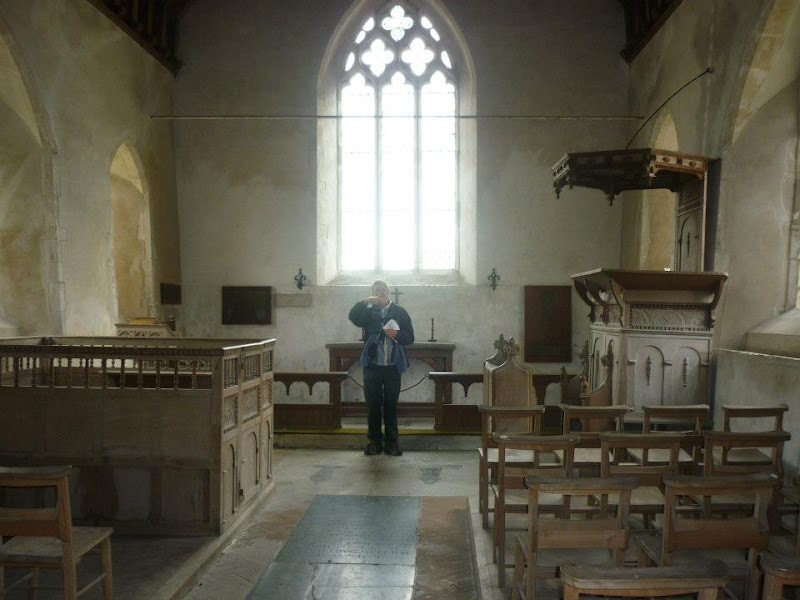
From Hoxne, the path wanders away from the river through a tunnel of shrubs and vegetation to the village of Brockdish. Where the path turns to follow a field border up to the village, one can look back and scan the vista of the Waveney valley where the river disappears into a small wood. The trees obscure a small church on the Suffolk side of the river in the parish of Syleham, known as the church of St Margaret. It is said that it was in this very building that Hugh Bigod, 1st Earl of Norfolk, surrendered his allegiance to King Henry II in 1174, relinquishing his castles at Bungay and Framlingham in the process.
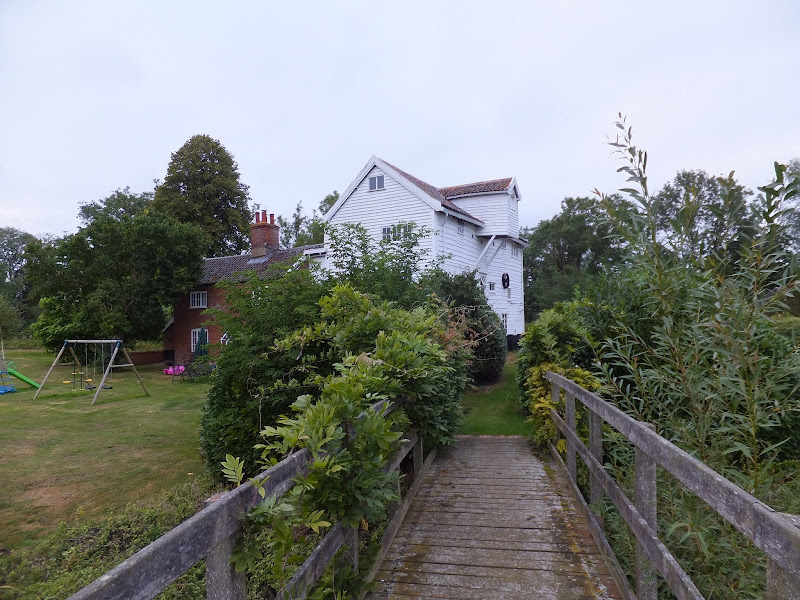
Beyond Brockdish, the route crosses the river onto the Suffolk side and passes through some delightful wooded pasture-land. The path eventually emerges at Weybread House, a large tidy house with well kept garden that sits alongside the site of an old watermill that was known as Weybread Mill. Built in the 1700's the large mill worked up until 1920 when it sadly burned down. According to the Norfolk Mills website, The Eastern Daily Press reported this as
A disastrous fire occurred at Weybread on Friday evening, when the water and steam mills carried on by Mr. J. Button, of Diss, with the valuable contents in machinery, plant, and stocks of wheat and flour were destroyed. The country for miles around was illuminated by the huge tongues of flame, and hundreds of people from far and near gathered to watch the fire. Mr. Button, his father, and grandfather before him, have carried on an extensive business at the mills for many years. The origin of the fire is unknown.
All that is left today is the millpond but it is obvious that a mill once stood here.
Obstacles and Challenges
This particular walk diverts away from the Angles Way to Wortwell where there is a campsite and a pub. The official trail passes through the quaint village of Mendham then follows the contours of the hills that wind up the river valley. At Downs Farm, a footpath leads across Limbourne Common where there is a river crossing by the renovated Limbourne Mill, the site on which a mill has existed since the 11th century when it was recorded in the Domesday Book, whilst the Angles Way continues along the contour to Homersfield.
The juncture between these two routes is clearly defined with waymarkers for both paths, however the footpath across the common, on this particular occasion, was blocked up by a farm gate that had been securely tied across the entrance to the common. It was obvious that this was purposely set in this position and the only way to enter the common was to clamber the precarious and unsteady structure in order to get across. For any nimble footed walker this does not present much of an obstacle but for dog walkers or those not of such nimble foot this may present a problem.
Zen and the Art of Motor Vehicle Avoidance
Despite long distance footpaths being largely off road, with every attempt to keep the route to footpaths and tracks, there are inevitably sections that have to be routed along roads. This can be down to a lack of alternatives or diversions due to works and maintenance or temporary re-routes caused by landslips or floods. On this section of the Angles Way there are numerous sections of road walking but the majority of these are little country lanes that are a pleasure to wander with hardly a motor vehicle to contend with. However, there is one particular short section between Weybread Mill and the footpath that leads into Harleston that negotiates a road on which particular caution should be taken. The road in question is a link between the B1116 with the Harleston bypass and, although not busy, it is used as a short cut for vehicles heading toward Diss. To all intents and purposes the road, on first impressions, appears to be nothing more than a little back-road with verges and hedgerows encroaching upon the tarmac, no pavement and little evidence of it being anything other than a quiet lane. But, do not be deceived. This road can be hazardous as cars can and do hurtle around the junction from the B1116 without any regard to potential walkers that may be following the route of the Angles Way.
As is the case with all road walking one should follow the advice of the Highway Code which clearly states
keep to the right-hand side of the road so that you can see oncoming traffic. You should take extra care and be prepared to walk in single file, especially on narrow roads or in poor light keep close to the side of the road. It may be safer to cross the road well before a sharp right-hand bend so that oncoming traffic has a better chance of seeing you. Cross back after the bend.
This is sound advice and keeps one aware of any immediate danger posed by traffic heading in ones direction.
This advice was followed as we headed to the junction with the B1116 which was a slow bend curving around to the right with a tall hedgerow somewhat masking the corner which presented a hazard. Even so, at this point the road was wide as it broadened to meet the junction and as such did not appear to warrant the need to cross the road to negotiate the corner. This assumption was probably incorrect as was demonstrated when we were confronted with a van speeding around the corner, which then sharply swerved as the driver unexpectedly caught sight of us two walkers, single file and against the verge. True, as a pedestrian observer, the speed of the van appeared to be far in excess of what one would expect a vehicle to take such a junction. The driver took umption. You could see the grimace on his face and the obvious expletives that were fired at the two inconsiderate walkers he had encountered. He obviously felt that he was most certainly in the right and it was a divine right that he should be able to proceed along this section of road at a rate up to and including the national speed limit.
Motorists and walkers often appear to be at contention with one another. Though, we must remember a little set theory here and the group that encompasses all motorists has an intersection with the group that encompasses all walkers, and I suspect this intersection is a rather large one, i.e. there are a lot of walkers who are also motorists. I also suspect that we can enlarge upon this and say that there is a subset of the group of motorists which I shall call 'angry motorists' as not all motorists are as inconsiderate as the one encountered on this section of road. This subset is all those motorists who get irate at anything that hampers their progress along the highway, and that hindrance includes walkers. It would be interesting to know whether this subgroup intersects with the walker group. I have a sneaky feeling that it does. Such an intersection would conclude that certain walkers, who, when allowed to be unleashed in charge of a mechanised beast, become somewhat disassociated with the walker group that they are also a member of. This makes it quite complex, as a member of the walker group can also be a member of the motorist group but are exclusive to one particular group at any one point in time. So that is not an intersection in the classic meaning of the term but a sort of weird pseudo-intersection between groups. They are either a walker or a motorist and at no time can they be associated with being a member of both groups. I think this is a good theme for a late night discussion around the campside fire with a warming glass of whiskey.
To go back to the advice of the Highway Code, I would like to offer some other advice that I have adopted after several experiences of close encounters with angry motorists whilst walking roadsides. If the curvature of the bend is shallow then I usually adopt the policy of holding out a light coloured object into the road to give a little more warning to approaching traffic. An OS map is a perfect object. This does not have to be held at arms length, but a few inches away from the body which gives a little more visibility to traffic approaching around the bend. In more extreme cases when the road sharply bends right and is coupled with hedgerows obscuring the view then once again follow the highway code advice and cross the road, cautiously negotiate the bend, walking with the traffic keeping a constant eye on the road behind.
Having said all this I would like to point out that in all the walking I have undertaken the occasions of real danger or close encounters are extremely rare and confrontations with angry motorists even rarer. The crossing of the main A143 Harleston bypass was probably more dangerous than this section of road.