Route details, maps, pubs, features, local history and folklore for a wide variety of walks focusing primarily on Norfolk and Suffolk

find_in_page

Keyword Search Results

Walks
Showing posts sorted by relevance for query butley. Sort by date Show all posts

Suffolk Coast Path - Orford to Butley Ferry

A 6.5 mile Suffolk circular walk along the banks of the Ore and Butley rivers between Orford and the Butley Ferry river crossing at Gedgrave.

The Suffolk Coast Path Orford Loop has two routes back onto the main trail, the first returns from Orford up to Chillesford but an alternative is to follow the lane from Orford to Gedrgrave and down to Butley Ferry. Although this crossing only operates from April to October, a pleasant and easy circular walk can be made from Orford returning along the top of the river defences.

The Sandlings Walk - Bromeswell to Snape

Wantisden church

A 16 mile walk along the Suffolk Sandlings Path between Bromeswell and Snape taking in Rendlesham and Tunstall forests

The route leads across gorse covered heathland and through forest which typifies the modern landscape of the Sandlings. The forests are a modern development, set up with the founding of Forestry Commission during the 1920's to provide Britain with a sustainable source of timber. One cannot fail to notice the twin airbases of Woodbridge and Bentwaters, the scene of a infamous military encounter with a UFO during December 1980.

Walk Statistics

  • Start location: Bromeswell 
  • End location: Snape Maltings 
  • Distance:   miles (  km)
  • Total Gain:   ft (  metre)
  • Total Descent:   ft (  metre)
  • Min Height:   ft (  metre)
  • Max Height:   ft (  metre)
  • Est. Walk Time:  
  • Walk type: Linear
  • Walk Grade: Easy
  • Terrain:

Maps

The following maps and services can assist in navigating this route. There are links to printed maps and links to downloadable GPX route data for importing into navigational software and apps.


Transport

Service
Service Details
Unfortunately there is no longer a regular bus service that serves Snape Maltings therefore there is no public transport to connect the two ends of this walk. The nearest bus service by continuing along the Sandlings path would be Friston, but this would involve a change at Saxmundham. At the other end, the 800 service links Bromeswell, Melton and Woodbridge but is not very regular so it is beneficial to start the walk from Melton. It is always worth using the Traveline website in case any service becomes available
Timetable

View in OS Map | View in Google Map

Image of pub
Address
Woodbridge Rd, Butley
Website

This village inn dates back to 12th Century and still retains many old features such as oak beams, and a cast iron fire surround which allegedly dates from the 1700's and the walls are adorned with local photos and articles. Tax records show that the pub was known as The Great Oyster in 1617

After over four years of closure the pub reopened in March 2017 and is a charming, warm, rustic old pub, unspoilt by the rigours of age. The owners added an on-site shop and a microbrewery but despite this in 2019 the pub once again closed its doors. The future is currently uncertain with possible change of ownership or purchase by the local community.

Review (2010-04-03)

Adnams ales on offer, a roaring fire to sit in front of and some old locals telling us about the history of the old inn. Perfect.

Plough and Sail, Snape View in OS Map | View in Google Map

Image of pub
Address
Snape Maltings, Snape
Website

There has been a pub here since the 16th century, when it was a smugglers inn at the head of navigation on the River Alde. Throughout this period and right up until 1965 the pub was also the focus for the sailors who traded barley on the Thames Barges that berthed on the quayside.

The pub was taken over in April 2012 by twin brothers Alex and Oliver Burnside. They offer quality seasonal food produced from local suppliers as well as local ales. There is a spacious restaurant, a cosy bar and intimate balcomny area. Seating is provided in front of the pub and there is a courtyard at the back.

Review (2010-04-03)

A final pint of Adams Explorer before the bus home. Although the air was cool it was still warm enough to sit on the bench outside and reflect on the great days walk.

Features

Gobblecock CottageView in OS Map | View in Google Map

This somewhat amusing name is probably derived from the old Suffolk name for a turkey-cock which was known as a gobble-cock and could reflect the keeping of turkeys in days gone by. This 19th century rubble flint thatched cottage is a grade II listed building. This cottage is the sole surviving intact example of a gamekeeper's cottage on this shooting estate.

The Sandlings ForestsView in OS Map | View in Google Map

The area of East Suffolk known as The Sandlings is characterised by extensive unfertile sandy soils. This is the domain of hardy plants that can survive this habitat: gorse, bracken and heather are abundant throughout this area.

The first world war brought realisation of how much timber was imported into this country and after hostilities ceased The Forestry Commission was set up to provide a home grown timber resource. Naturally the farmers and landowners from the Sandlings area were eager to sell their poor quality land to this new organisation and thus in 1921 the forests were set up at Rendlesham, Tunstall and Dunwich.

The combined forests cover about 8648 acres of the former Sandlings. The great storm of 1987 devastated much of Rendlesham forest with over a million trees being blown down. Since then the forest has been replanted with a more varied mix of trees to include both conifer and broadleaved varieties intersected with clearings, wetland and heath to provide a varied habitat that encourages wildlife and fauna.

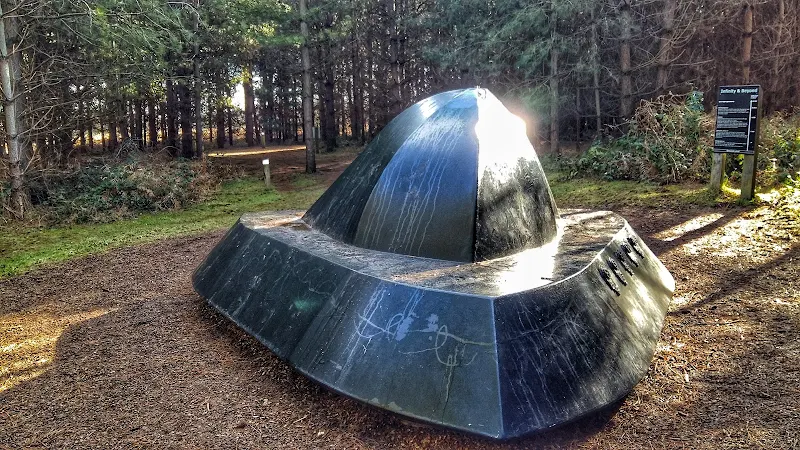
Each forest area has public access. Rendlesham Forest has been enhanced with cycle and walking trails including the UFO Trail to commemorate the landing and encounter with a UFO by USAF Servicemen in 1980. Sometimes referred to as The British Roswell, this event happened over several days of the Christmas period of 1980 and witnessed by dozens of military servicemen as well as civilians. The UFO Trail navigates from The East Gate of RAF Woodbridge, where the UFO was initially witnessed landing in the forest, and leads through the forest on the alleged route the servicemen travelled to where they found the unknown craft landed, and which is now marked by a sculpture. Full details of a walk incorporating this trail can be found at An Extended Walk around the Rendlesham UFO Trail.

The forest also includes activity areas and regularly hosts events including Theatre in the Forest. A camping area provides access for those who want to stay over in these delightful surroundings.

Staverton ParkView in OS Map | View in Google Map

The area north of RAF Woodbridge, to the east of Rendlesham forest is known as Staverton Park. It is thought that this was originally a deer park created between the 11th and 13th centuries. Records show that during this time that the abundant oak was used in a wide variety of manners. This included bark for tanning leather, acorns for pig feed as well as the usual timber and fuel.

Later, during the 16th century the oaks started to be pollarded which was done on a 50 year cycle. During this period there was also Staverton Hall located to the south west of the present woodland in what is now Rendlesham Forest

Today the site, described in 1986 as 'a famous and awesome place of Tolkienesque wonder and beauty' is a Special Area for Conservation (SAC) and a Site of Special Scientific Interest (SSSI). The ancient woodland consists of oak and birch with some holly trees which are said to be the largest in Britain. It has an awesome woodland of ancient oak and birch, and part of the site has holly trees reputed to be the largest in the UK. It may have been a deer park in the Middle Ages and there is a fenced-off area for these mammals now. Privately managed.

Wantisden ChurchView in OS Map | View in Google Map

Wantisden church, dedicated to John the Baptist, can be found on the track that leads around the eastern perimeter of RAF Bentwaters. There is no road access to this remote church and up until the 1950's it was positioned within the enclosure of the military area. This necessitated a military escort for those who wanted to visit the church.

The significant feature of the church is the coralline crag tower of which there are only two examples in the county, the other being at nearby Chillesford. The tower dates from the 15th century and is curious by the fact that it has no battlements.

Route Validation Cards

Validation Date - 2010-04-03

  • Time of Walk: 09:30 to 16:00
  • Validators: Griffmonster, Kat
  • Weather Conditions: Cool but bright. Odd threat of a shower but nothing eventually occurring
  • Notes: Initial route undertaken

Validation Date - 2014-12-19

  • Time of Walk: 07:00 - 14:00
  • Validators: Griff
  • Conditions: Clear day after previous days rain
  • Notes: As ever, I got a little lost in Rendlesham Forest
Summary of Document Changes

Last Updated: 2026-01-12

  • 2021-03-17 : Update website improvements and removal of ViewRanger reliance
  • 2021-12-01 : Removal of ViewRanger links due to its imminent demise

Suffolk Coast Path - Snape to Felixstowe

Looking bck towards Shingle Street from Bawdsey

A 20 mile walk along the Suffolk Coast Path between Snape and Felixstowe

This is the most remote section of the Suffolk Coast Path and follows the Butley River down to Shingle Street and then continues along the coast to the ferry at Bawdsey. There is an eerie sense of foreboding when walking this section. The solitude. The windswept landscape. The distant silhouettes of the Orfordness Pagodas. The lonely river. One can walk virtually the entire distance without seeing a soul and the only company is the decaying remains of WWII defences and the looming martello towers from Napoleonic times.

Suffolk Coast Path - Snape to Felixstowe - Essential Information

Walk Statistics:

  • Start location: Snape 
  • End location: Felixstowe 
  • Distance:   miles (  km)
  • Total Gain:   ft (  metre)
  • Total Descent:   ft (  metre)
  • Min Height:   ft (  metre)
  • Max Height:   ft (  metre)
  • Walk Time:  
  • Walk type: Linear
  • Walk Grade: Easy
  • Terrain: Footpaths, defence banks and tracks

Maps:

The following maps and services can assist in navigating this route. There are links to printed maps and links to downloadable GPX route data for importing into navigational software and apps.


Transport:

Details of public transport that is required for the walk

First Group - Bus Service
Service Details
64 - First Group 64 service connects Ipswich, Woodbridge, Wickham Market, Saxmundhamm, Leiston and Aldeburgh.
Timetable
First Group - Bus Service
Service Details
75/76/77 - First Group 75/76/77 bus services connecting Ipswich, Trimley and Felixstowe.
Timetable
Ferry Service
Service Details
Ferry Service from Bawdsey to Felixstowe Ferry - Operates daily from May to September. Pre book during winter months. See Suffolk Ferry leaflet for further details.
Timetable

Route Verification Details

  • Date of Walk: 2012-06-08
  • Walk Time: 07:30 to 15:00
  • Walkers: Griffmonster, Kat
  • Weather Conditions: Blustery and overcast day

Walk Notes

I have no doubt that this is the least walked section of the Suffolk Coast Path. It is an extensive hike with little public transport apart from at either end of the walk with only one bus in each direction each weekday that passes through Snape. This means once you start the walk, you are committed to its length unless you have an accomplice to pick you up from Shingle Street or are equipped with camping gear when there is a site off route at Hollesley. Even when Bawdsey is reached, the ferry has to be running in order to get across the Deben where civilisation is reached, then its another couple of miles to get the buses into Ipswich. However, taking these restrictions into account one can catch the early Anglian bus from Leiston to Snape then return from Felixstowe via Ipswich.

The first time I walked this section was back in 2007 on a sunny summers day in August. On that occasion the only people I saw throughout the entire distance was a couple by the Martello Tower at Shingle Street. The rest of the distance was in complete solitude and despite the summer weather the morning dew was laden on the overgrown grass of the river defences which completely soaked my trousers, boots, socks. There was no good in appealing to the gods because out here in this remote part of Suffolk, no-one can hear you. As usual, I was prepared, and a fresh pair of socks got me through the remaining distance.

On this occasion, accompanied by Kat, we encountered a few more people; a couple of dog walkers in Tunstall Forest, a pallid figure huddled by the ruins of a brick building by the banks of the Butley River, glaring out across the waters. He never spoke. We never spoke. At Shingle Street we encountered several groups of teenagers with hiking packs who were heading off in different directions, undertaking some orienteering exercises. There was clearly debates going on between them about the route to take, and exactly where they were on the OS maps they were pointing definitive fingers at. Even so, what a great way to spend teenage years. Out in the wilds, learning map-reading.

A little later, a couple with a dog crossed the path and headed up a footpath to Alderton. Apart from these brief encounters, the bulk of the walk was as expected, alone with nothing but the grey clouds, brisk winds and stark landscape for company. This wind was putting white horses on the choppy old sea giving that annoying doubt that maybe the Bawdsey Ferry would not be operating in such conditions. Then we would be stuck. An additional 10-15 miles to get to public transport! Fortunately this was not the case and there were a crowd of people waiting for the ferry. On quieter occasions the ferry has to be hailed by waving the provided bat in the air.

I still contest that there is an air of foreboding throughout this walk. I am not sure what generates this feeling. The solitude. The silence. The desolate marshes. The mysterious Burrow Hill looming oddly above the marshes. The concrete structures that stand ominously on Boyton Marshes. The empty hut where the Butley Ferry should depart. The discarded rowing boat on Simpson's Saltings. The omnipresent Orfordness lighthouse lurking in the distance, standing clear above the secretive concrete Pagodas that are silhouetted on the horizon. This part of the coast is full of the ghosts of conflicts of days gone by. WWII pill boxes, the Bawdsey gun battery, the Line of Martello Towers. Then amid this length of marshy desolate coastline is the beach-side hamlet of Shingle Street. A place full of untold secrets, rumours and stories unearthed over the years about what really went happened during the 1940's. The tales of burnt German bodies and the rumours of setting the sea alight to ward off a German invasion.

Despite all of this it is a part of the Suffolk Coast Path that is well worth exploring. Its desolate nature is its beauty. The solitude is its charm. The ghostly secrets are its heritage and today's fascination. And there is also Tunstall forest which is a complete contrast from the coastal section and the curious Burrow Hill which used to be an island in the Butley River estuary and some say is an ancient Saxon burial mound. There is no specific place to take a rest, so one has to make do with whatever comes along. Close to Hollesley there is a pillbox sinking into the ground and this provides an apt place to climb on its roof and sit down and gaze across the landscape. An experience and savour.

Whilst researching some of the background to this walk I came across a reference to a long line of white shells stretching across the shingle at Shingle Street. The formation was made and by a lady of the name Lida Kindersley who survived cancer and created the line as a mark of thanks. She still maintains its upkeep, fixing breaks caused by walkers, tide and weather. This is something to look out for another day, but reference to it can be found at Brianhuman's Blog

At the Bawdesy end of this route there has been some considerable erosion over the years. At the point of the old WWII gun battery the erosion has taken land right up to Rose cottage and the Martello Tower that lay just beyond East Lane. Rock defences have been placed along the cliffs in an attempt to arrest the erosion. There is no access along the beach here at any state of the tide and one has to navigate inland up East Lane to the road down to Bawdsey. There was access back to the beach along a track just past Bawdsey Hall, but this has now been prevented by more erosion and one has to walk through to Bawdsey ferry via the road.

Boyton Marshes AFV Range

Directions

The Suffolk Coast Path leaves the Alde estuary at Iken to head inland through Tunstall Forest and then follows the Butley River and the Ore down to Shingle Street where it follows the coast to Bawdsey. A ferry service connects Bawdsey with Felixstowe Ferry where the promenade leads into Felixstowe town.

Snape to Butley Ferry

The coast path follows the Alde estuary from the southern side of Snape Maltings. This uses boardwalks across the marshes to Iken cliff where the path heads up the hill to the road. Turn right on the road and then left along a track down to a farm. The waymarker here has fallen down into the hedgerow which can be misleading. Keep to the farm track down to the farm and follow it around to the left and beyond the reservoir where another track leads off to the right. Take this keeping alongside the woods on the right until there is a gap in the trees. Walk through the gap and continue in the same general direction on the opposite side of the trees. This keeps to the boundary of a couple of fields until a thick row of trees is encountered on the right. A waymarker points down the side of the trees, follow this all the way through to the road. Cross the road and enter Tunstall Forest. A small path leads through the trees and emerges onto a broad track through the forest. When the track bends to the right, continue straight ahead onto another footpath and keep to this in a straight line, crossing a road, until it emerges from the forest onto a track down to Chillesford. Turn right, past the Froize Inn pub and take the road on the left.Keep to this down to Butley Mill, then take the track on the left beyond the Mill. Keep to the track until it emerges onto a little road at Butley Low Corner, a small hamlet made up of a few houses. Turn left and follow the road to the end then right and onto another track. This leads down to Burrow Hill which lurks ahead. The continues directly over the hill and down the far side where a footpath leads off to the left and up onto the River banks of the Butley River where the ferry operates during holiday seasons.

Butley Ferry to Bawdsey Ferry

Follow the river banks. The Butley River soon joins the River Ore (which is called the River Alde further up the estuary). Keep to the path with the river to your left, the sea parallel to this beyond and drainage ditches to your right. This path leads all the way through to road down to Shingle Street. Either follow the road or take the river banks down to Shingle Street and continue past the beach-side houses to the Martello to the south. The path leads inland just beyond the tower, then up onto a defence bank. Keep to this all the way down to the East Lane Gun Battery. A road then leads up to Bawdsey. Keep bearing left then take a left on the road to the ferry. Just beyond Bawdsey Hall the official route crosses the fields back down to the beach and there is a strenuous walk across the shingle and around the estuary to the ferry - this is now inaccessible due to erosion with the steps down to the beach having been swept away. The alternative is to follow the road down to the ferry.

Felixstowe Ferry to Felixstowe Town

Keep to the promenade that follows the estuary round to the sea. Keep to this until the beach-side road on the top of the cliff turns inland. There is a path up to the road. Keep to the road until there is a small roundabout. Turn left and the buses into Ipswich depart from across the road. The railway station is just through the shopping area beyond the bus stop.

Bat for hailing the ferryObservation Tower at Bawdsey Battery
On the left Bat for hailing the ferry; On the right Observation Tower at Bawdsey Battery

Pubs

The Ferryboat Inn, Felixstowe Ferry View in OS Map | View in Google Map

Image of pub
Address
The Ferryboat Inn, Felixstowe Ferry
Website

The site of the inn was originally a fisherman's hut for selling fish and dates back to 1043. The present building dates from the 15th Century when it was the home to the Ferry master. It became a hostelry in the 16th Century. The hamlet it sits in is presently known as Felixstowe Ferry which dates from the 19th century. Before this time is was known as plain Felixstowe and the present town that bears this name was then known as the Waltons.

The Inn offers a range of food with daily specials displayed on a blackboard. Guest ales are available.

Review

A worthy pint of ale and beef baguette after a long walk

Martello Tower at Bawdsey East Street

Features

The Shingle Street MysteryView in OS Map | View in Google Map

The first houses in Shingle Street were built in 1810 soon after the construction of the Martello Tower that stands to the south of the hamlet. In those days the mouth of the River Ore was just to the south of Shingle Street and the houses were built for the local fishermen who also acted as river pilots. Up until the second World War there was a pub at Shingle Street called the Lifeboat Inn but this was flattened by an uncharged chemical bomb devised by Porton Down after the military evacuated the village and mined the beach. It was during the war years that the Shingle Street mystery occurred. There have been many documentaries and reports about the mystery's, rumours and tales that surround Shingle Street and even today there is no conclusive evidence as what exactly occurred. Many locals testify to the events but the official line is that it didn't happen and was purely disinformation put about by the powers that be in order to keep up the British Morale after suffering the defeat at Dunkirk.

The story unfolds soon after the British allied defeat at Dunkirk in 1940 which had left British morale in tatters and left the military short of hardware which had to be abandoned during the retreat. British intelligence had caught wind of 'Operation Sea lion', a German plan to invade Britain along the South Coast. This is well known about but there was also a second German operation to invade the poorly fortified Suffolk coast, in particular targeting a six mile stretch of coastline between the mouth of the River Ore to the Harwich Harbour. British intelligence had noticed the build up of troops at Belgium and French ports and hastily sought counter measures to defend the vulnerable Suffolk coastline. Shingle Street itself was evacuated in order to mine the beach and use the buildings as target practice. But with limited resources and with the knowledge of an impending invasion the military covertly added in another line of defence. At selected parts of the East Anglian coast they lay a network of underwater piping just below the low tide line. At the sign of imminent invasion they would pump the pipelines full of fuel and then set the sea alight to prevent the enemy landing.

It was one Saturday in late August 1940 that such a threat became reality. A flotilla of German warships had already set out from Belgium and French ports headed for Britain. As they approached the Suffolk coast during the evening of that fateful Saturday, the order was given to set the sea alight. The defence was a total success by the fact that it repelled the attack as the fleet was engulfed in the inferno. At Aldeburgh there was a serviceman's dance being held at the Jubilee Hall which was cut short and the Local Defence Volunteers were put on red alert as they watched the sky being lit up in the distance accompanied by gunfire and explosions. In the aftermath many local people witnessed hundreds of burned bodies of German soldiers being washed up along the shore. Some bore witness to them being loaded onto army trucks and being carted away. Those involved were told that the operation was top secret and not to talk to anyone about it. Civilians were threatened if they if they did not keep silent on the sights they had witnessed and the whole thing was hushed up. According to the authorities nothing happened, there was no invasion, no sea set alight and no burned bodies washed up on the Suffolk beaches and any story about such was pure disinformation. This official explanation remains in place to this day but many who were involved, now in their later years, have come forward with testimonies of what they had witnessed. Maybe the full truth will never be revealed but one cannot ignore these veterans who state that they were there.

A website has been set up dedicated to the Shingle Street mystery and includes many testimonies, letters and articles from those who were involved in both the sighting of the sea ablaze and the clear up of burnt bodies in German uniform. It is an intriguing and curious mystery.

References

Boyton Marshes AFV RangeView in OS Map | View in Google Map

Where the Butley River meets the River Ore and heads south towards Shingle Street, on the landward side is an area known as Boyton Marshes. It was here that during WWII an Armoured Fighting Vehicle range was constructed. A triangular track was laid where tanks would tack around and fire live ammunition at tank shaped targets that were towed along a narrow gauge track built into earth banks which provided shielding. These were controlled from a series of large concrete block houses with smaller block houses controlling flip up targets for the tank machine guns.

Three of the block houses are still intact and are visible on the marshes from the Suffolk Coast Path, their curious form being completely different from the usual pill boxes that are encountered along the coast. These curious concrete structures with sloping sides almost resemble some kind of rocket launchpads and appear quite eerie amid the stark flat landscape.

Website detailing WW2 defences in Suffolk
References

Bawdsey Gun BatteryView in OS Map | View in Google Map

At Bawdsey the coast path heads inland to navigate around the coastal erosion. At this point there are the remains of Bawdsey Gun Battery which was part of Harwich Fire Command and built in 1940. This concrete structure, partly concealed below ground, housed the magazines, watch shelters and gun stores and was connected to the guns by covered passages. There is also the remains of the distinctive Battery Observation Post. This two storey building includes a basement housed an armoury, a telephone room and a range-finder. There were also barracks, messes, ablutions and stores in a spinney at the rear of the battery. The most notable aspect of any visitor to the gun battery is the metal grill on the upper story of the observation tower which spells out the words 'Prisoner of War'

This structure forms an integral part of one of the most complete 20th century coastal batteries in existence (and 7 out of 116 Emergency Batteries), relating to the rapid enhancement of Britain's coastal defence in the early stages of the Second World War.

Shingle Street
Shingle Street

Gallery

Below are a selection of images taken from from the photo album for this walk. Feel free to browse through these or click on an image to view a larger version in the Gallery.

Summary of Document Changes

Last Updated: 2021-12-07

2012-11-22 : Initial publication
2018-12-15 : General website updates + inclusion of ferry links and route changes caused by erosion at Bawdsey
2021-03-17 : Update website improvements and removal of ViewRanger reliance
2021-12-01 : Removal of ViewRanger links due to its imminent demise
diversity_3

Popular Walks