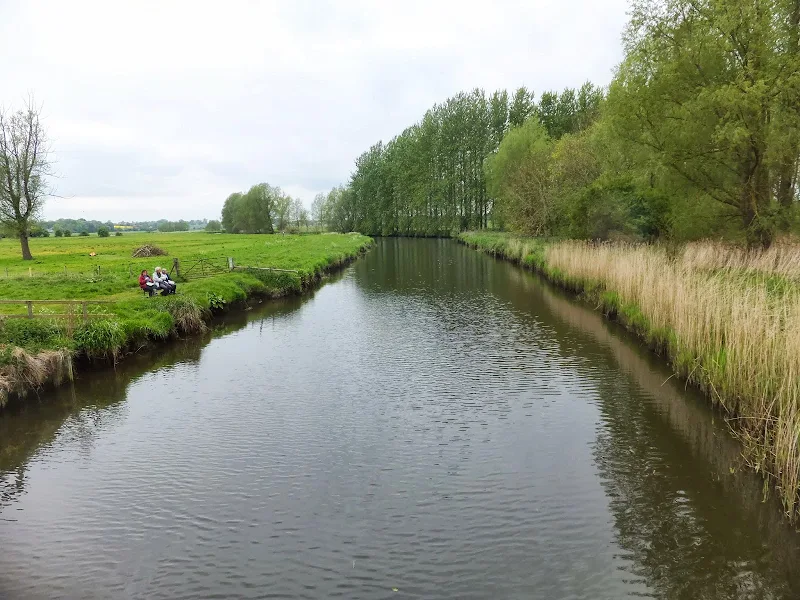
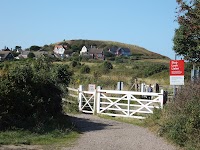
A scenic riverside walk linking Beccles with the historic Geldeston Locks pub, this route offers meadow paths, peaceful stretches of the River Waveney, and glimpses of Norfolk’s rich folklore and heritage. Perfect for an afternoon outing, it combines gentle countryside walking with a memorable stop at one of the region’s most characterful pubs.
A 10 mile walk following the southern side of the parish boundary of Leiston in coastal Suffolk.
This is the second article devoted to the walk following the route of a 17th century perambulation around the southern side of the Leiston Parish boundary. This article concentrates on two landmarks from the past, namely Sizewell and Thorpe Beacons, which are thought to have been part of the Armada early warning system.
The Marriott's Way links Aylsham and Norwich following the former trackbed of the Midland and Great Northern Railway.
The Marriott's Way is a footpath, bridleway and cycle route, which follows the routes of two disused
railway lines, and runs between the historic market town of Aylsham and the medieval city of Norwich. Along with the mileage markers which are crafted from old rails, complete with a metal rubbing plaque, there are numerous concrete sculptures, village markers, interactive sound boxes and benches which all provide interest and information along the route.
A 10 mile circular walk around Leiston and Eastbridge in Suffolk
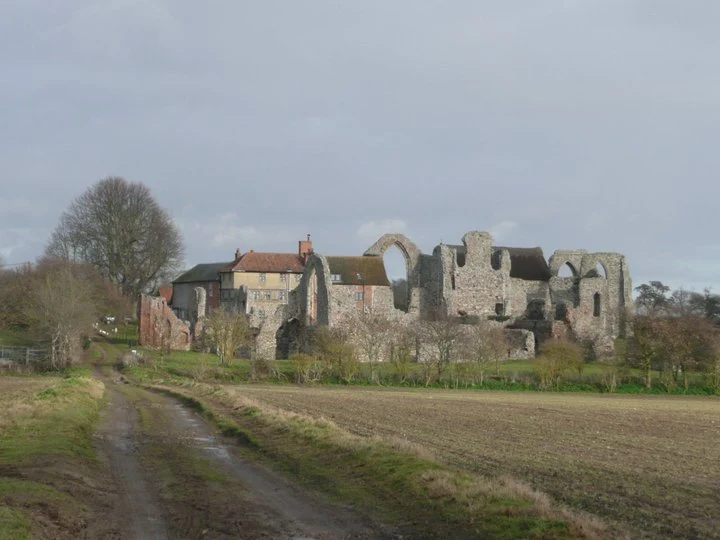
Leiston Abbey was originally founded in the late 12th century by Ranulf de Glanville. The original building was constructed on an island in the Minsmere marshes. Two centuries later, due to the inhospitable conditions on the marsh and constant flooding the Abbey was moved inland, lock stock and stone to a site close to Leiston. Despite a great fire in 1367 and much demolition following the dissolution of the monasteries there still remains some impressive ruins. There is still a remnant of the old Abbey, with the former chapel building sitting in its island position above the marsh, decaying into the landscape and containing a WWII pill box. This walk visits both sites making a well worthwhile walk.
A 13 mile circular walk along the Sandlings Walk between Knodishall and Snape
With limited public transport this walk offers a circular route to incorporate the Sandlings path from Knodishall to Snape. Starting and ending at nearby Leiston it incorporates The Sailors Path and the Suffolk Coast Path to make a worthwhile day walk. The route passes Friston mill and Hall and the burial grounds where a Saxon burial ship was discovered. With pubs at Friston and Snape it provides for a great days ramble.
A 16 mile walk along the East Suffolk Line Path between Leiston and Wickham Market
Although the official route for the East Suffolk Line Path links the stations at Saxmundham and Campsea Ashe, this provides an alternative route using the local bus service to link the two ends. Highlights along the route include the picturesque Beversham Mill and the legendary Blaxhall Stone (a little off route) which is said to progressively grow in size.
An 8 mile walk along the Angles Way from its start at Great Yarmouth to Belton
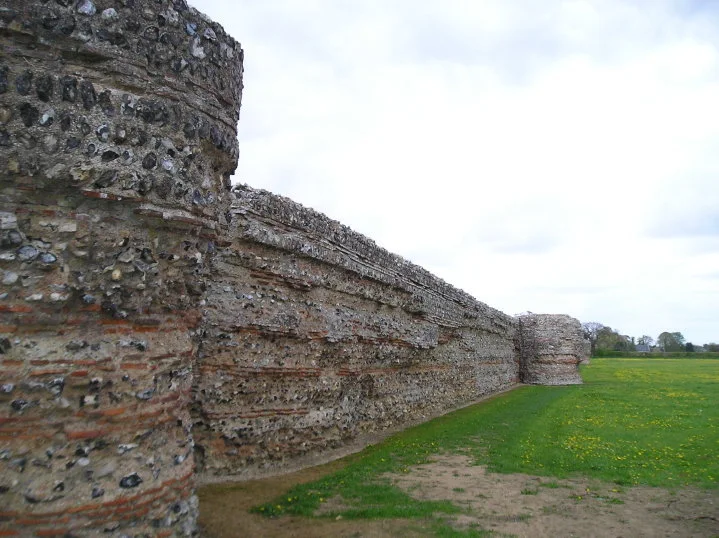
The journey along the Angles Ways begins with a walk along the banks of Breydon Water to Belton. Along this route can be seen the impressive remains of the Roman fort Gariannonum at Burgh Castle. This is a simple afternoons walk with a frequent bus service linking Great Yarmouth and Belton for the return journey. On this occasion we walked the path in reverse having set up camp at Belton.
A 19.5 mile walk along the South West Coast Path between the Yealm and Estuaries, using additional footpaths to access transport to link each end of the walk.
There are ferries across both the Avon and the Yealm estuaries but this route takes a trail that enables navigation around them using footpaths and lanes. Even so, there is still the Erme estuary to negotiate midway along the coast. There is no ferry here but it can be waded across one hour either side of low tide. This is quite an experience but requires planning with reference to the tide times published for Devonport. There are few other features apart from the stunning scenery along this section of the coast walk until it gets to Bigbury on Sea where Burgh Island sits just off the coast and hosts the renowned Pilchard Inn. The island can be reached on foot at low tide and at other times the inn makes use of a sea tractor to drive visitors across.
An 8 mile walk around Suffolk's Alton Water Reservoir
Located on the Shotley peninsular, the Alton Water Reservoir provides an easy walk around its water. A self contained circular route that needs little in the way of maps. Just keep the water on your left and keep walking! The mixed variety of landscapes of open meadow, woods and even the hills on the northern side of the reservoir provide a constant changing scenery throughout the walk.
A challenging walk along the South West Coast Path between Langton Matravers to Swanage
Not quite a circular walk, with bus to connect the missing distance between Langton Matravers to Swanage. Some amzing coastline with a memorable climb to the top of St Adhelms Head.
A fine piece of walking along the Essex Way to provide some glorious views of the Stour estuary before turning inland to avoid Harwich and Dovercourt. Estuary views, marsh, woodland and open fields make for a varied scene throughout the walk.
A 7 mile walk following the western parish boundary of Leiston in Suffolk, as described in a document from the middle-ages
This walk attempts to follow the instructions of a perambulation around the western side of the Leiston Parish boundary that was undertaken in the year AD1620. Leiston's history is renowned for its Abbey and the Garret's works, but this walk also discovers the site of a possible ancient pre-Christian shrine or temple, the location of the Leiston gallows and the procession route taken by those attending this gruesome public spectacle.
Simple and pleasurable wander along the river estuary with plenty of river craft to see. The HMS Vale, a former Swedish Navy HUGIN class vessel built in 1978 and decommissioned in 1995 now resides on the river bank as the Deben Vale Cafe Bar. This cafe serves as a unique vantage point to have a drink and bite to eat whilst admiring the view of the vast expanse of the river Deben.
A 7 mile walk around coastal North Devon from Hele Bay to Berrynarbor
This walk takes inland footpaths and tracks to navigate from the village of Hele Bay through to Berrynarbor, which, with its whitewashed stone walls takes on the guise of a Mediterranean village. The village plays host to numerous flower pot men in comical poses which makes an intriguing spectacle as one wanders through the streets. Return is along the South West Coast Path
NOTE
This is a walk summary intended to provide the user with just the essential information in order to navigate the walk route. Fully detailed information notes, refreshment stops and walk features are not included in this. A full write up will be included in the near future.
Hele Bay to Berrynarbor Circular Walk - Essential Information
The following maps and services can assist in navigating this route. There are links to printed maps and links to downloadable GPX route data for importing into navigational software and apps.
Situated close to Ilfracombe, this family owned holiday park is set in the picturesque valley at Hele Bay. It offers a peaceful, clean and well maintained park with static caravans and lodges, camping pitches and camping pods. This site has been awarded Silver Awards from the Devon Tourism Awards, a David Bellamy Gold Award for Conservation and a Trip Advisor Excellence Certificate.
Route Verification Details
Date of Walk: 27/06/2021
Walk Time: 10:30 to 15:30
Walkers: griff, kat
Weather Conditions: overcast, some drizzle
Walk Notes
This walk provides a simple yet slightly challenging circular wander around the north Devon countryside between Hele Bay, east of Ilfracombe and Berrynarbor, with a return section along the South West Coast Path. This features some glorious views, timeless villages and the glory of the South West Coast Path.
In this instance, camp was set up at the Hele Bay camp site and the starting point for the walk, Cat Lane, runs alongside the site with access from the road leading into the campsite, or alternatively through the gate at the end of the site which opens out onto the farm at the end of Cat Lane. For those who are not familiar with the area, take the right turn when entering Hele Bay from Ilfrcombe, just before the petrol station - a sign post indicates the campsite at this point. Follow the road down and around the bends. Where the road turns a sharp right, take the lane that diverges off to the left. This is Cat Lane and after a brief steep ascent the going levels out.
View back to the coast
Both Cat Lane and the rear access of the campsite meet at a cluster of farm buildings. This is known as Comyn Farm, which in addition to being a working farm offers two cottages for Bed and Breakfast. The public footpath negotiates a course through the courtyard that separates the buildings before leading around the left hand side of the far building. The path is almost hidden but a waymarker points the way into the undergrowth and across a stream with conveniently placed stepping stones to provide a way across the waters. On this occasion it was pretty simple series of steps across what was no more than a trickle of water but during rains, no doubt this becomes a bit of a challenge to negotiate.
The footpath leads through the woodland that accompanies the stream up the valley, eventually crossing a bridge across the stream to start heading up the hillside of rough pastureland and populated by plenty of sheep. The path climbs higher and higher and higher. The views back get more and more panoramic with the coast soon easily picked out. The route leads to a group of farm buildings where the path emerges onto a tarmac track. Initially this looks like the top of the climb, but past the buildings and there is more climbing. Higher and higher and higher before it eventually levels out. From Comwyn farmhouse the climb ascends some 120m.
The track junctions a narrow country lane, and on the opposite side is a stone stile with a waymarker pointing down into the Sterridge valley beyond. The footpath is easily picked out by the darkened colour of the grass as it leads across and down the grass hillside. This crosses a hedgerow full of trees and leads towards a more dense area of woodland. Keep to the well marked route and where there appears to be more than one path choose the well worn route. Either way it all leads in the same direction following a tree lined hedgerow. At the bottom of the hill there is a five bar gate that bars entry out onto a lane beyond. A track to the left briefly runs parallel to the road and then turns sharp right to lead out onto the lane.
Drunken flower pot man
The lane leads through a hamlet of Sterridge made up of quaint countryside cottages. One cant help but notice the preponderance of numerous flowerpot men that are placed in the gardens and on the outbuildings of the cottages, each figure taking up a unique pose. A sniper atop a shed, a flower pot child attired in wellies with a kids windmill in hand, another wellied example sits reading Enid Byton's The Famous Five and another sits by a stream with bucket and spade and a fishing net. One has to keep ones eyes peeled high and low to see them all as they are placed in the most awkward of places such as the golfing flower pot man balanced half way up a wall with a golf club hitting a golf ball. MY favourite was the somewhat pickled looking flower pot man atop a hedge, cradling an empty glass and an empty bottle of wine.
At first these works of art are just a comical catch of the eye but one soon finds that ones eyes are drawn into the flower pot world, searching for more curiosities. A lady passed us and offered a witty word saying that we had to pay to look at them. She informed us that all these items were the work of a local man and he is credited to having created some eighty of the figures that are placed around the village, although she confessed they may not all be in place these days.
St Peters church at Berrynarbor
Continuing onwards we come into the main part of the village of Berrynarbor and are greeted by the church of St Peter, a Victorian restoration from an original 13th century building with 15th century tower. A slate sundial adorns the wall above the South porch and is dated 1767. Unfortunately the day is overcast and the time is cloaked in shadow which leaves us to deduce the hour by the fact that the local pub, Ye Olde Globe, is closed indicating it was before midday. I guess the same deductions were undertaken in times of old but the question is how did the landlord know the time. I guess he just looked at the sundial and in times of cloud, just had a good guess!
The pub sits amongst the terraces of whitewashed cottages and the scene down this road would not look out of place in a Mediterranean coastal village when the sun shines and the sky is blue. The pub is clearly identified by the sign and the building dates from 1675 when it was converted from existing cottages. These cottages are said to originate from at least 1275 when they were employed as accommodation for the stonemasons building the church. The fact that this is a freehouse is certainly encouragement to visit for any ale enthusiast but it is closed, and there is no sign of the landlord inspecting the sundial so opening time is not imminent. Therefore, with the prospect of afternoon rain heading our way the decision was taken to continue onwards.
Watermouth harbour
The return route is along the SWCP. This is accessed directly across the main road at the junction with the Berrynarbor road and leads down the Old Coast Road. There is brief evidence of this highway as it passes the well presented Sandy Cove Hotel, and then it disperses into no more than a track through some woodland before emerging out onto the Watermouth Park Camping Park. Below these cliffs is a brief glimpse can be seen is Broadsands Beach. This includes a secluded cove where steep steps lead down to it.
The route leads down to Watermouth harbour where there is a cafe in a boat. It is an idyllic place to stop at the head of this natural harbour enclosed by the mainland on the left and a promontory on the right known as Sexton Burrows. At the tip, by an area known as Burrow Nose is a circular ruin. A path leads out to this for those with an inquisitive nature. It is only a 10 minute walk out there and well worth the excursion. The ruin looks like it could be some kind of lighthouse or day mark for shipping, or even a windmill. Curious cured patterns around the interior indicate some roof structure. There is little information about this and the only reference I have found speculates it being a 19th century lookout tower associated with Watermouth Castle, the ornate castellated building on the opposite side of the road to the entrance to the harbour. Although named a castle this was just a 19th century country house, and these days has been converted to a theme park.
Ruin at the tip of Burrow Nose
The path then negotiates around Widmouth Head and Rillage Point which enclose Samsons Bay before leading up to the coastguard cottage on the main road. Then there is a simple walk alongside the road back down into Hele Bay.
A walk through the Suffolk countryside between Halesworth and Bungay
The walk navigates through the Suffolk farmland and incorporates historic churches and the ruins of a Saxon minster. A great way to spend a day walking
A circular walk taking in the Weavers Way, Honing and Dilham
This walk explores a part of the Weavers Way long distance trail, taking in the restored Honing station before departing to follow the Dilham canal around to the village of Dilham where the Cross Keys pub provides a worthy place to take a break.
A walk across the coastal Suffolk countryside to the village of Middleton
A splendid way to spend a days walking, cross fields and countryside and heading to the location of the Middleton Watermill. There are churches to stop and investigate on the way.
This is a walk summary intended to provide the user with just the essential information in order to navigate the walk route. Fully detailed information notes, refreshment stops and walk features are not included in this. A full write up will be included in the near future.
Leiston to Middleton Mill Circular Walk - Essential Information
Walk Statistics (calculated from GPX):
Start location: East Runton
Distance: miles ( km)
Total Gain: ft ( metre)
Total Descent: ft ( metre)
Min Height: ft ( metre)
Max Height: ft ( metre)
Walk Time:
Walk Grade: Easy
Terrain: Footpath, Track, country lanes
Maps:
The following maps and services can assist in navigating this route. There are links to printed maps and links to downloadable GPX route data for importing into navigational software and apps.
There appears to be no documentation about the watermill which was said to exist to the north of Middleton village. The mill is long gone and only reminder to its history lies in the name of Watermill Farm that sits besides the Minsmere river. This river is no more than a small stream at this point and it is a wonder that such a small flow of water could power a watermill. Maybe there was a millpond here once upon a time, a p[lace to store the water until there was a volume powerful enough to drive the wheel. The landscape around here reveals nothing, with the river surrounded by trees.
Despite the lack of a watermill, this nonetheless provides a purpose to the walk and the sheep filled meadows that leads to the farm are a delight to walk through. Equally delightful is the area known as Middleton Moor, the hamlet aboce the valley where there is a green with a pond and an old water pump.
The Public Rights of Way (PRoW) within the Suffolk Coastal area between Aldeburgh and Southwold are subject to being blocked up and diverted due to the extensive industrial projects that are currently taking place in the area including the Sizewell C development and various wind farm projects. A PRoW Access page has been written to detail known issues in the area
Latest walk summaries are basic information sheets for walks that have yet to be fully documented. These provide links to maps, public transport and walks stats, although detailed notes and features are not included.