Route details, maps, pubs, features, local history and folklore for a wide variety of walks focusing primarily on Norfolk and Suffolk

OSmap:209 Walks
Showing posts with label OSmap:209. Show all posts

Tuesday, 10 December 2019

The Icknield Way - Baldock to Fowlmere

An 18 mile walk along the Icknield Way between Baldock and Fowlmere

Although not renowned for its hills, this part of Hertfordshire has some high ground which gives fantastic views out across Hertfordshire and Cambridgeshire and the Icknield Way sticks to the higher ground all the way from Baldock to Royston. There are numerous picturesque villages and hamlets along the route with leafy green tracks and trails to make it a jolly fine days walk.

The Icknield Way - Baldock to Fowlmere - Essential Information

Walk Statistics:

  • Start location: Baldock 
  • End location: Fowlmere 
  • Distance:   miles (  km)
  • Total Gain:   ft (  metre)
  • Total Descent:   ft (  metre)
  • Min Height:   ft (  metre)
  • Max Height:   ft (  metre)
  • Walk Time:  
  • Walk type: Linear
  • Walk Grade: Some gentle hill climbing
  • Terrain:

Maps:

The following maps and services can assist in navigating this route. There are links to printed maps and links to downloadable GPX route data for importing into navigational software and apps.


Accommodation:

Apple Acre Camp siteView in OS Map | View in Google Map
Description
Apple Acre Camp site, Fowlmere - please note that this is no longer a touring site, having been repurposed as a residential development with homes for the retired and semi-retired.

Route Verification Details

  • Date of Walk: 2009-06-20
  • Walk Time: 09:30 to 16:00
  • Walkers: Griffmonster
  • Weather Conditions: Lots of thick clouds with sunny spells and warm

Walk Notes

The Icknield Way expedition had little planned as an experiment into determining how far one could reasonably walk in a day. One thing that had been learned over the years of walking with a group is that one has to keep to the pace and ability of those who are the least able. That is not a criticism but an observation. A group has to act as one and therefore the least able effectively sets the days mileage. Once one is walking alone then it is a case of setting ones own targets. Therefore there had been no overnight accommodation booked. This ultimately resulted in a wild camp for the first night. Now, after walking for 1.5 days and covering some 40+ miles with full kit I was determining the optimum mileage whilst keeping within ones limits. Therefore, I had phoned ahead the previous evening to the only campsite within reasonable distance of the trail beyond Royston to ascertain pitch availability. Wild camping is fine but it lacks certain basic services and to put it bluntly it is illegal in England.

The last few miles from Royston to Fowlmere was along the main A505 which I definitely do not recommend. This is a major east-west artery with a huge amount of traffic and no real path along the verge. On reflection it would have been far better to have walked the extra couple of miles down the Icknield Way then cut across using the B1368.

The days walk on the whole was really pleasant. There was plenty of warm sunshine and the views through to Royston were quite spectacular - I had never thought of Hertfordshire as having such high ground. I would hasten to add that on parts of this walk there was some ambiguity as to the correct route. There are numerous other paths and trails intersecting the Icknield Way and the waymarkers are not always easily located - an OS map is essential.

As I walked down the track named Park Lane, just beyond Sandon, the tranquillity of the countryside was shattered by a very loud engine. At first, I considered this was just farm machinery until an old single seater plane hurtled low above the lane. This had obviously just taken off and I tracked it as it manoeuvred across the sky. At the end of Park Lane the route turns back on itself up another track marked as Notley Lane on the OS map. At the start of the track is a house shielded by the thick hedgerow of the lane. As I walked past the plane came down to land in the gardens of the house. I could just see the pilot in his goggles and headgear. A unique sight on any walk, and one I have never witnessed before or since. I would have taken photos but the hedgerow was too thick to gain a decent view.

At the end of the day I watched the sun go down at my camp and paid homage to the sungod with a 'ta, ra, boom de ay' and a couple of bottles of ale which an old friend and former workmate brought over to me on a visit from Stevenage.

Directions

The Icknield Way exits Baldock on Lime Kiln Lane - at the bottom of this road the path continues across the A505 Baldock bypass just before the road disappears into a tunnel. The path gently climbs the hill towards Clothall where it turns back on itself just before the village is reached. Further gentle climbs results in a walk along the top of the hills through to Wallington. From here the route meanders through the hamlets of Redhill, Row green, Sandon and Therfield before descending down into Royston. This part is not altogether clear and regular consultation of guide book and OS map is needed. At Royston there is a little road walking through the town before the path heads back into open countryside at the junction with the Royston bypass. As I pre-booked a pitch at an official campsite in Fowlmere, I had to head off-route a few miles north of the A505.

On the left, Sundon village and church, just one of the many quaint hamlets and villages on this section. On the right, Therfield Heath leading into Royston.On the left, Sundon village and church, just one of the many quaint hamlets and villages on this section. On the right, Therfield Heath leading into Royston.
On the left On the left, Sundon village and church, just one of the many quaint hamlets and villages on this section. On the right, Therfield Heath leading into Royston.; On the right On the left, Sundon village and church, just one of the many quaint hamlets and villages on this section. On the right, Therfield Heath leading into Royston.

Pubs

Fox and Duck, Therfield View in OS Map | View in Google Map

Image of pub
Address
Fox and Duck, Therfield
Website

A locals pub that welcomes walkers and visitors. Ales are from Green King and all food is locally sourced with an extensive steak menu and even dog biscuits for the dog. Accommodation includes 3 en-suite rooms. The landlord, John Luce, used to be the bass player with Welsh entertainer Max Boyce.

Review

Very busy pub on account of it being Fathers Day. I elected for a pint of St Edmunds Ale, a seasonal Green King light coloured ale which had a hint of vanilla to its taste which is certainly not my favourite taste to a pint of beer. Very pleasant experience sitting with weary legs propped up on the wooden benches that sat on the green in front of the pub and watching numerous cyclists passing through the village.

The Queens Head, Fowlmere View in OS Map | View in Google Map
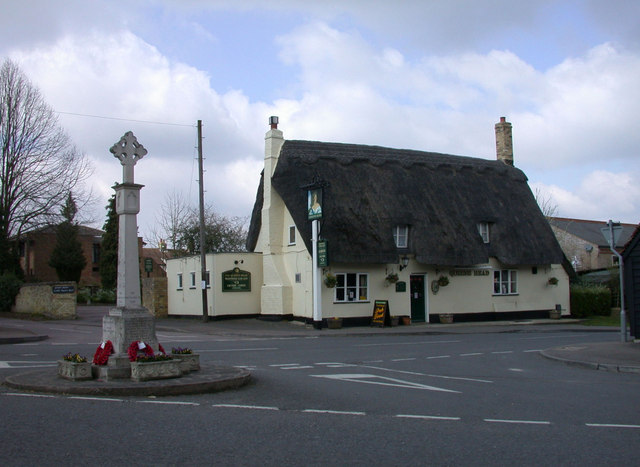
Image of pub
Address
The Queens Head, Fowlmere

17th century timber-framed and plastered building with a thatched roof. Food served.

Review

Unfortunately when I popped in here the food had finished for the day (this was at 8pm). Standard Greene King ales were on offer and I opted for Abbott Ale.

Swan House, Fowlmere View in OS Map | View in Google Map
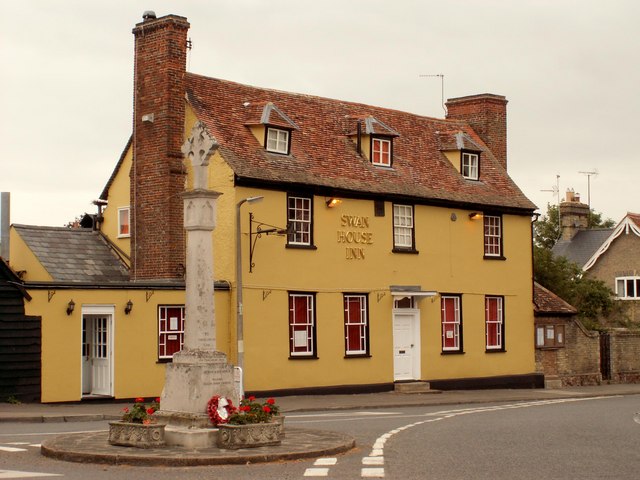
Image of pub
Address
Swan House, Fowlmere
Website

This former pub dating from the 16th century is now an Indian Restaurant. Standard Indian fayre and drinks.

Review

Decent enough food with the standard Cobra beer.

Views across Cambridgeshire

Features

WallingtonView in OS Map | View in Google Map

Although not born in the village (featured as the main picture of this blog), Eric Blair, better known to the world as George Orwell, lived and was married in the church here. He kept the village sweet shop from 1936 until after the second world war.

Therfield HeathView in OS Map | View in Google Map

Therfield Heath, also known as Royston Heath, is a common on the chalk escarpment just north of Therfield. The highest point on the heath is 551ft from where you can see for miles across the flat Cambridgeshire countryside. There are five Bronze Age barrows and a neolithic longbarrow, which was reused in anglo saxon times, as well as numerous other round barrows on the heath.

RoystonView in OS Map | View in Google Map

Royston stands on the crossroads to two ancient thoroughfares, the Roman Ermine Street and the prehistoric Icknield Way. There is a cross at the intersection of these routes, variously known as Royse's, Rohesia's or Roisia's Cross. The cross gave the settlement its earliest name of Crux Roesia or Roisia's Cross. By the 14th century this had become Roisia's Town, Roiston or Royston. A large boulder of red millstone grit, bearing a square socket, is supposed to be the base of the cross, and has been placed by the cross roads at the northern end of High Street.

Royston CaveView in OS Map | View in Google Map

Royston Cave is a unique 14th Century man-made cavern in the shape of a beehive, with a small aperture at the top for ventilation. It was re-discovered in August 1742 by a workman digging a hole in the Butter Market in order to get decent footings for a new bench for the patrons and traders. Within the cave are an extensive range of Christian wall carvings as well as pagan symbols. The builders and usage of the cave remain a mystery and speculation and theories range from the Knights Templar, Freemasons, a hermitage or prison through to a spiritual centre at the crossing of two significant lay-lines.

Buttercups in the meadow behind the houses at Row Green

Summary of Document Changes

Last Updated: 2021-12-07

2010-12-03 : original publication
2017-12-19 : general updates
2019-12-10 : New responsive format + map updates + links updates +text updates
2021-03-17 : Update website improvements and removal of ViewRanger reliance
2021-12-01 : Removal of ViewRanger links due to its imminent demise

Sunday, 20 January 2019

The Icknield Way - Fowlmere to Linton

A 16 mile walk along the Icknield Way between Fowlmere and Hinton

The path keeps to the ridge along the hills, though the land now flattens out as it heads eastwards. There are picturesque villages and hamlets as the route winds its way through some traditional old English countryside.

The Icknield Way - Fowlmere to Linton - Essential Information

Walk Statistics:

  • Start location: Fowlmere 
  • End location: Hinton 
  • Distance:   miles (  km)
  • Total Gain:   ft (  metre)
  • Total Descent:   ft (  metre)
  • Min Height:   ft (  metre)
  • Max Height:   ft (  metre)
  • Walk Time:  
  • Walk type: Linear
  • Walk Grade: Easy
  • Terrain:

Maps:

The following maps and services can assist in navigating this route. There are links to printed maps and links to downloadable GPX route data for importing into navigational software and apps.


Accommodation:

Crown Inn, LintonB&BView in OS Map | View in Google Map
Website
Description
Bed and Breakfast at the Crown Inn, Linton

Route Verification Details

  • Date of Walk: 2009-06-21
  • Walk Time: 08:00 to 15:00
  • Walkers: Griffmonster
  • Weather Conditions: Light grey skies with occasional sun and warm

Walk Notes

The previous evening I had taken an excursion off route to find a place to pitch at a small campsite at Fowlmere. This provided a cheap pitches for hikers and was in close proximity to the village where there was the usual amenities for food and drinks. For this days walk I had managed to find a bed and breakfast accommodation at The Crown Inn in the Cambridgeshire village of Linton, some 16 miles ahead which gave ample time to cover the distance and to enjoy the walk. This was somewhat heartening as I had covered some 60 miles in three days and it was a welcome relief to have a few miles less to cover.

The previous evening an old friend had joined me at camp, bringing along a few bottles of ale. There was one left. Marstons Old Empire, a well hopped IPA. At 5.7% this was not to be tangled with and with due consideration it was something to celebrate at the end of the days walk. But then the thought of carrying extra weight in my bag for a day gave second consideration. One always needs to reduce weight as much as possible when hiking with a full kit and having bottles of beer was taking the idea of necessities a bit too far. There was only one thing for it. Breakfast beer. The bottle was opened, the rich nectar plundered and the camp de-pitched to saunter off with a sprightly spring in my step!

The walk started with a stroll down the lane onto the main road from where there is a short walk along another lane down to the Icknield Way trail. Now, this was early morning, sometime around 7.30-8am and the A505 trunk road was heaving. A mass of traffic in both directions. Commuters going between Royston and Cambridge. Never ending lines of traffic with one person in each car. The freedom of the highway. Staring up someone else's exhaust. It took more than several minutes to cross this monstrosity. Waiting for a moment when there was a break in traffic travelling in both directions then taking ones life in ones hands to sprint across. It was a relief to hanker away from that turgid road, back to the solitude of open countryside.

The Icknield Way was rejoined at Heydons Ditch which is assumed to be a Saxon earthwork that was probably dug out for defence purposes. It leads up the hill to the village of Heydon, climbing some 90m over 1.5 miles. Once past the modern brick houses at the start of the village, one passes typical English thatched cottages, then there is a triangular green with a bench on it with the village church opposite. A place to sit and take it all in for a few minutes before continuing the journey. This was to set the theme for the day, with the numerous Stereotypical English villages that adorn the hills along this part of the trail. When I say hills, this is nothing like the Cotswolds this is just higher ground.

Next village is Chrishall with its duckponds and then Elmdon which once boasted a Norman castle although all that exists now is a mound. The its on to Strethall. Each village is connected with paths through cultivated fields. This really is rural England in all its glory.

Beyond Strethall the path descends down the hills to cross the M11 motorway. This is a along a straight track across the fields that leads into Great Chesterford. It runs along the course of an old Roman Road and has large hedges, somewhat overgrown either side of the narrow footpath.The going became difficult, with thoughts of battling out through one hedge and walking the field-side. I persevered, blindly pushing forward through the undergrowth and the overhanging branches. A rabbit hole caught me out and left me stumbling with a twisted ankle. Thankfully no serious damage was sustained from this mishap.

A footbridge traverses the motorway and drops down onto a road which runs alongside the railway to a crossing. The crossing is one of the modern automated barrier kind and the lights were flashing and the gates down. Alongside this, down in a gulley is an alternative route under a bridge. But for any avid train spotter the crossing is worth standing at. As did a car. It must have been driven by a train spotter. We waited. And waited. Straining ears to listen to an approaching locomotive. But nothing. It must have been five minutes at least if not more when the barriers started to move upwards having no visible train pass. But before they lifted to the full extent, the descended back down and we had to wait for another invisible train. These new classes of invisible train reserve a particular disdain among the train spotter fraternity as not only can they not be seen but the object of collecting their number is even even more of a challenge. When the barriers finally lifted I had witnessed two invisible trains and had not a clue what numbers they were. I shall underline them on the blank page at the back of the locospotters book, obviously a page dedicated to invisible engines.

The route passes the Crown and Thistle pub in Great Chesterford. A welcome break before the last section to Linton where the benches outside allowed me to remove my boots and put my feet up without shocking a customer base with aromas of sweaty soles. An hour was spent here slowly supping on a pint and watching life go by without a care in the world. Eventually one has to get back to the purpose in hand, re-lace the boots, strap on the gear, deposit the glass in the pub and head off, back up the hills. As stated previously, these are not obvious hills, but one still climbs to 114m on this stretch of the walk and from the highest point on Great Chesterford Common one can gaze down to Linton in the valley beyond. The Icknield Way is an ancient track and the obvious choice would be to follow the ridges of hills which would be less susceptible to boggy and marshy conditions.

Directions

From Fowlmere take the Chrishall Road down to the A505. Turn right and follow the A505 for a few hundred yards where a minor road on the left takes you back down to the Icknield Way. the ancient Icknield Way crosses this road at Three corner Plantation but the modern route is found by taking the track on the right for 300yds where the route takes the Heydon Ditch on the left. From here follow the waymarkers through Heydon, Chrishall, Elmdon and Strethall. The path now heads northwards where it joins a former Roman road from Braughing and Great Chesterford which is now just a path between two hedgerows which are pretty overgrown and can be a challenge to get along. Eventually this path crosses the M11 and enters Great Chesterford. Paths across fields lead the remaining distance through to Linton.

Heydon Ditch leads up the hill to Heydonan interesting sign at the duck pond in Chrishall
On the left Heydon Ditch leads up the hill to Heydon; On the right an interesting sign at the duck pond in Chrishall

Pubs

Crown and Thistle, Great Chesterford View in OS Map | View in Google Map

Address
Crown and Thistle, Great Chesterford
Website

A traditional pub dating from the 16th century when it was a coaching inn. The pub is renowned for its food. Guest ales.

Review

There are two wooden benches on the side of the road in front of the pub which are good for walkers to rest their feet and watch the world go by. They had two ales on offer, Adnams Bitter and Fullers London Pride. The Pride was very satisfying.

The Crown Inn, Linton View in OS Map | View in Google Map

Address
The Crown Inn, Linton
Website

Large building offering B&B, in a self contained block at the rear of the building. A brasserie-style restaurant offers a variety of food including daily specials which features fresh fish and meat dishes sourced from local suppliers. Guest ales on offer.

Review

There was a distinct lack of staff when I turned up at 4pm. As I waited on the benches at the side of the pub one resident declared that he was fed up with the lack of service and was collecting his belongings to transfer to another pub further up the road. No complaints about the beer and food though. I stuck with Woodfordes Wherry throughout the evening, a personal favourite at the time. It was young, fresh and full of hops as it should be.

Chrishall village sign the former Braughing to Great Chesterford Roman Road, now just an overgrown track between two hedges that leads out to the M11.
On the left Chrishall village sign ; On the right the former Braughing to Great Chesterford Roman Road, now just an overgrown track between two hedges that leads out to the M11.

Features

Heydon DitchView in OS Map | View in Google Map

The Heydon Ditch is a large earthwork that runs in a straight line from Heydon to Fowlmere. It would have consisted of an earth bank and ditch but most of this has now been lost to agriculture. The present day Icknield Way follows its course from close to the A505 down into Heydon. The ditch is said to date from Saxon times and was built as either defences or enclosures. Local legend dating back hundreds of years states that it is haunted by the ghosts of giant warriors, and headless Saxon skeletons were uncovered during excavations in the 1950s.

ChrishallView in OS Map | View in Google Map

The village of Chrishall was listed in the Domesday Book as Cristeshalla, or "nook of land dedicated to Christ" which is one of only two English settlements whose name contains the word "Christ". At 482ft above sea level, the village is the highest point in Essex. Following the Norman Conquest the area around Chrishall was given to Eustace of Boulogne who built and occupied a house on a hill to the south of the current church. He named the house "Flanders" and it was there that his daughter Matilda of Boulogne, later wife of King Stephen was raised. The house survived until the 15th century, and is believed to have stood on the site of Chiswick Hall, itself built in the 17th century by Sir John James. The church of The Holy Trinity dates from the 12th Century and is Grade I Listed Building.

ElmdonView in OS Map | View in Google Map

Along with Strethall and Chrishall, Elmdon is one of the Essex ridge villages which remained isolated since the main roads passed them by. Until the 19th century its chief industry was woolcombing and weaving worsteds and fustians. Today Elmdon is a commuter village at the meeting of three roads. This central point consists of a small triangular green, where the war memorial is sited and surrounded by many picturesque cottages.

StrethallView in OS Map | View in Google Map

The name of Stretshall means 'nook' or 'sheltered corner' on the 'street' – a reference to the Roman road which ran through here from Braughing to Great Chesterford, following the line of an even more ancient trackway. Whilst the present day village can only be approached up two dead-end roads, it was once a major communication route in this part of the world. Local legend tells of a story during the civil war where three Royalist brothers named Richards were besieged in the manor house by Parliamentary troops from the camp on Thriplow Heath. The brothers escaped, having held off the Roundheads for a day and a night. Another legend tells of the shooting of a gypsy by a farmer named Nehemiah Perry in 1849. Perry lived in the manor house into which the gypsy accompanied by two others had broken into. Perry caught them on the staircase and shot Abraham Green dead. At the inquest a verdict of Justifiable Homicide was recorded and Perry was congratulated on his courage. The corpse was initially displayed in the Church tower for a few days for identification which enabled an enterprising sexton to charge 3d to would-be viewers. After no-one claimed the body, Perry despatched it in a game hamper to his medical adviser, Dr George Paget, at the Cambridge University Anatomy School. To this day, the skull of Abraham Green can still be seen in the Duckworth Collection of the Department of Biological Anthropology while about half of his bones are kept in the Museum of Zoology.

Great ChesterfordView in OS Map | View in Google Map

The ancient village of Great Chesterford sits on the banks of the River Cam. It has been inhabited by Bronze Age followed by the Romans who erected many buildings including a tax office and a temple and alos built a wall around the town. The church of All Saints dates from the 13th century, and has had many additions over the years. Local legend tells of the silver bells which hung in the church tower and were hidden in an underground passageway which ran between the Church, the Old Vicarage and the Crown House Hotel to keep them safe from government soldiers. They have never been found, although some traces of the passageway have been uncovered.

Summary of Document Changes

Last Updated: 2021-12-07

2010-12-15 : Initial publication
2016-11-05 : General website updated
2019-01-20 : General website updates and rewrite of notes
2021-03-17 : Update website improvements and removal of ViewRanger reliance
2021-12-01 : Removal of ViewRanger links due to its imminent demise

Indexes and Info

East Suffolk PRoW Access

The Public Rights of Way (PRoW) within the Suffolk Coastal area between Aldeburgh and Southwold are subject to being blocked up and diverted due to the extensive industrial projects that are currently taking place in the area including the Sizewell C development and various wind farm projects. A PRoW Access page has been written to detail known issues in the area

Walk Summaries

Latest walk summaries are basic information sheets for walks that have yet to be fully documented. These provide links to maps, public transport and walks stats, although detailed notes and features are not included.

Latest Walk Summaries

Featured Walk

In Search of Sizewell Chapel

A 10 mile walk following the southern side of the parish boundary of Leiston in Suffolk This walk follows the route of a 17th century peramb...

What is GPX

All you need to know about GPX, electronic mapping and how to use modern apps and mobile devices as navigation devices

Popular Walks

Maps

Diary of a Suffolk Common

The ramblings and musing of the Griffmonster