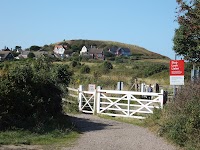
Despite the dampness and the drizzle as experienced on this occasion, this part of the South West Coast Path is a true delight. Not too strenuous but enough of a challenge to provide a sense of achievement. Either direction can be taken and the preference of the east to west in this case was due to the base camp being set up at Polzeath's Valley Park site, thus providing no specific schedule in which to complete the walk. A regular bus service runs between the two villages which is a short 20 minute journey and includes some Sunday services. At the time of writing this was operated by First Kernow.
Port Isaac, these days, is renowned as the location of the TV series Doc Marten. But that should be its only mention. The village does not need advertising. It is beautiful, charming and exquisite in its own right without the need of fictional TV doctor.
So the walk. The bus drops one off at the top of the village, where New Road turns a sharp right to continue up the coast to Port Gaverne. The Ruby Tuesday's Cafe is just along the road and advertises itself with the catch-line a meeting place, hub in the community, so come in, have a coffee, lunch, read the newspapers, peruse our menu and enjoy our cakes and cream teas
which very much describes this friendly little place. So why not? A cup of tea before one starts walking. A time to adjust the rucksack, to get the maps ready and to converse in anticipation of another great walk along this fantastic coastline.
Following the road towards Port Gaverne soon brings one to a cliff-top car park and the coast path runs along the perimeter of this and then continues around the coastline into the cove where the stereotypical Cornish village of Port Isaac nestles at the head of the Haven. One could spend a long time here exploring the narrow alleys and steep lanes and taking in the daily life and the comings and goings of its people. But for us walkers it is a sight to behold and then move onwards along the coast path. Another time and another day will be dedicated to exploring Port Isaac.
The route leads up and out of the village along Roscarrock Road, and the higher one climbs the less tourists one passes. A series of steps then leads onto a footpath across the grassy top of Lobber Point where solitude is found. No sooner than one is up, than the path descends down into Pine Haven. A descent down some 50m followed by a steep climb back up via a series of rough steps. The going then becomes a lot easier as it passes Varley Head, Greengarden Cove and to Scarnor Point. Here the path drops down by Reedy Cliff and follows a more winding route along the sometimes craggy landscape before rising back to the cliff top and out to Kellan Head. At this point the path turns and then descends down to what is left of the village of Port Quin, or as it used to be known, Port Guin, once a bustling fishing village but now just a handful of houses hunched up at the head of the cove. Quite what happened to this once thriving 19th century port is open to conjecture and hearsay with the usual tale being a storm which devastated both its fishing fleet and the village.
Today, there is a car park. And there is Fiona's Cafe. When I say cafe, it is not a cafe in the traditional sense of the word but an old Citroen van with a serving hatch that oozes character and a few benches on the grass for its customers to sit down. But that is all one needs. However, on this occasion the cafe was closed. Fiona was nowhere to be seen. Her van was there but her presence distinctly absent. The drizzle had thoroughly wetted the benches and we took shelter down by the concrete boat launch at the head of the bay. Well, when I say shelter, if one calls hiding under a waterproof jacket hood a shelter then that is all it was, sitting there on the damp stone wall watching a couple of surfers packing up in a car whilst we munched on a pastie delicately garnished with the freshest of Cornish drizzle. Now, no matter how depressing this may seem to the reader I can assure you it is far from such a state of mind. It was warm. It was tranquil. Who cares about the drizzle when the scenery is a sight to behold. Getting wet is all a part of it and quite frankly I could think of no better place to be on this damp day.
It would appear that Fiona's Cafe has changed name and is now known as The Salt Pig, on account of the these old Citroen HY panel vans being colloquially known as this van is known as Nez de Cochon
which translates as Pig Nose.
The coast path from Port Quin can be found just up the road that winds out of the cove. A stile hides in the hedgerow and the footpath leads out across a grass meadow with a curious castellated structure at the far end. This is Doyden Castle. It looks like a castle. To all senses and recognition it is a castle but in reality it is not a castle. It is a Victorian folly. Although the coast path does not pass immediately by it, it is worth taking 10 minutes out to wander to the front of this building to realize it is not a castle but a small little domestic building. This three story structure with arched windows and surrounded by a simple dry stone wall was built in 1830 by a local businessman, Samuel Symons. It is reputed that the sole purpose for this remote retreat was to entertain his excessive partying and gambling activities. These days the building is owned by the National Trust which it rents out as holiday accommodation but there are still the original wine bins on the ground floor from the wilder days.
An interesting aside to this location is that it was once the site of the so called Long Stone, a standing stone which can currently be seen on the grass island at the junction on the road between St Endellion and Port Quin. This 6th Century 1.5m tall stone is said to contain an inscribed chi-rho cross, an early form of a Christogram, as well as the Latin inscription BROCAGNI IHC IACIT NADOTTI FILIUS
, which translates to Brocagnus, son of Nadottus lies here
although recent sightseers have reported that the inscription is no longer identifiable, obscured by the mass of lichen that covers the stone. In 1873 Samuel Symons moved this stone to Doyden Head for unspecified reasons and there it remained until the end of 1932 when it was returned to its original position. The OS map from 1888-1913 clearly depicts an inscribed stone at Doyden Point as well as the remains of an inscribed stone at its original position named Long Cross.
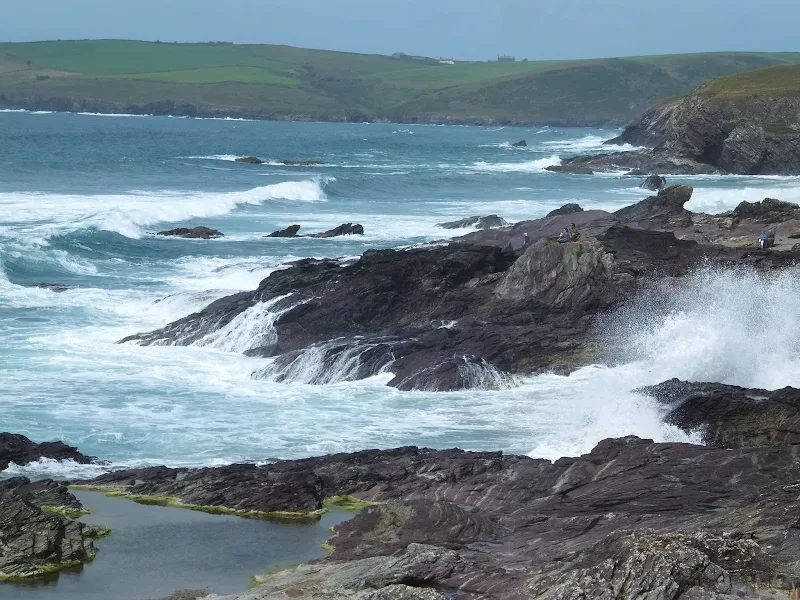
The path continues along the cliff-top, past Gilson's Cove and Pigeon Cove before dropping down to Epphaven Cove. A series of stone steps leads to the bottom, then it is a hop across the stream and back up the other side. The path soon passes Lundy Beach and then Lundy Hole, a collapsed cave that has left a tunnel through the cliff leading out to sea. Every passing walker has to stand and admire this marvel of nature and ponder over the local legend of how it formed which is presented in the feature to this walk. Briefly, the hole was formed when Saint Menefrida threw her comb at the devil to which he dug the hole in order to get away. Or so they say!
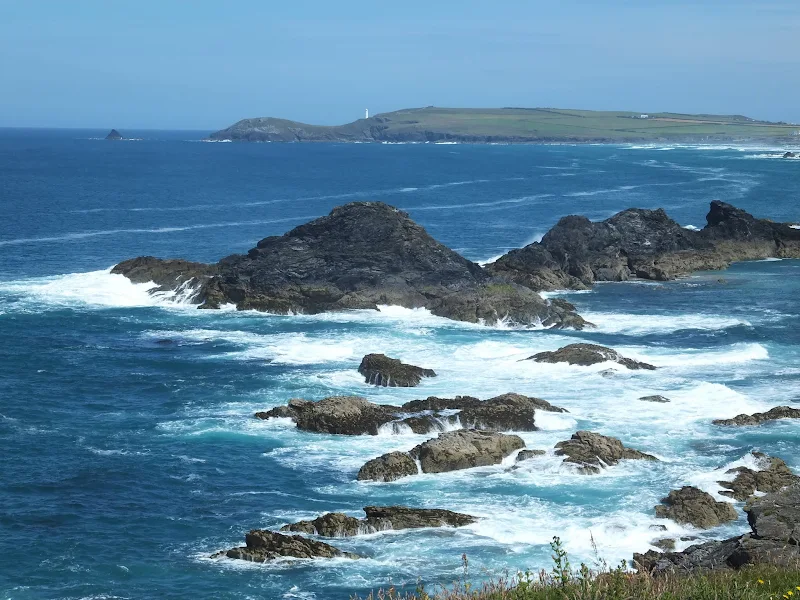
The path now climbs up to Carnweather Point and the first glimpses of The Rumps come into view. The going is fairly easy now all the way through to the Rumps and one can regularly meet dog walkers who take in the sights with a stroll out from Polzeath, a circular route which will be later covered on this website. The official coast path does not go out to the tip of the Rumps, but this is not easily determined from following the footpath as there are no waymarkers to point one around to Pentire Point. The path leads out to either side of the Rumps and presumably meets up on its far rocky front to the sea. However, if you don't know the track or the path it is always best to follow the general advice of the South West Coast Path of keeping to the main route. So follow the worn path that bends back round to the west side of the Rumps and continue on to Pentire point
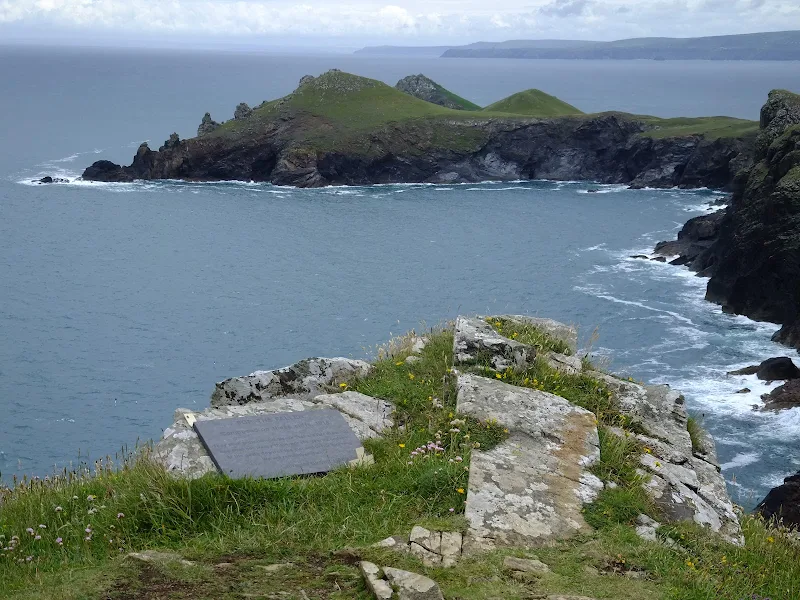
Looking back from Pentire Point one can see the Rumps from the opposite side, sitting there like a dormant dragon, its spiny backbone going down into the sea. At this point, as the path turns to descend down to Polzeath, on a rock on the cliff edge is a plaque. This is not always easily seen. Indeed, I managed to walk past it several times on walks around this coast before having it pointed out to me. The plaque is dedicated to the war poet Laurence Binyon who is said to have written the poem For the Fallen
whilst sitting at this point. The plaque is inscribed with the fourth stanza from that poem and is dated 1914.
They shall grow not old, as we that are left grow old
Age shall not weary them, nor the years condemn
At the going down of the sun and in the morning
We will remember them
Now the date is curious as one immediately feels that it should be at the end of the war rather than the year WWI broke out. A little research soon finds that Binyon was referencing the Battle of Mons on 23rd of August of that year when an Expeditionary British force encountered the Imperial German Army and suffered heavy losses
Polzeath has the excellent family run Valley Park camp site which is frequented by myriads of surfers. The village does tend to be expensive for food and drinks, and even a large portion of chips from the chippy is considerable more than the average chip shop emporium. The Valley Park site has its own reasonably priced bar where food is also available and the Oystercatcher pub can be found by going to the western side of the beach and following the road up the hill out of the village. It is only 10 minutes walk but is a steep hill and one deserves a pint by the time one gets to the top.