Route details, maps, pubs, features, local history and folklore for a wide variety of walks focusing primarily on Norfolk and Suffolk

Walks
Showing posts sorted by relevance for query Iken. Sort by date Show all posts

Wednesday, 9 January 2019

In Search of the Mysteries and Legends of Iken and St Botolph

A 7 mile walk along the Alde estuary, following the Suffolk Coast Path from Snape to Iken

There are disputes as to whether Iken is the land of Icanho that St Botolph was granted by King Ethelmund to build his minster in the 7th century. If it was then there were marsh demons in these parts during those time and one can still feel the eeriness of the area with the mysterious Yarn Hill where Botolph reputedly drove away the ghosts and marsh demons in order to build his minster. It was eventually completed on the site of the historic church at Iken which still bears his name. The church is a fascinating place to visit - be sure to spend a little time here and see St Botolphs stone cross which was unearthed in 1977 and is on display within the church.

In Search of the Mysteries and Legends of Iken and St Botolph - Essential Information

Walk Statistics:

  • Start location: Snape Maltings 
  • Distance:   miles (  km)
  • Total Gain:   ft (  metre)
  • Total Descent:   ft (  metre)
  • Min Height:   ft (  metre)
  • Max Height:   ft (  metre)
  • Walk Time:  
  • Walk type: Circular
  • Walk Grade: Easy
  • Terrain: Footpaths, tracks and country lanes.

Maps:

The following maps and services can assist in navigating this route. There are links to printed maps and links to downloadable GPX route data for importing into navigational software and apps.


Route Verification Details

  • Date of Walk: 2011-02-05
  • Walk Time: 12:00 to 15:30
  • Walkers: Griffmonster, Kat
  • Weather Conditions: Overcast and blustery winters day

Walk Notes

This walk was done on a cold and blustery early spring Sunday. There is a car park at Snape Maltings, which is worth using in order to take an hour or two perusing the Maltings before or after the walk. The Maltings have frequent craft and farmers markets offering a range of local wares and produce, as was the case on this instance. There is also a coffee shop and the Sail and Plough pub for refreshments.

One of the main reasons for walking this route was to catch a closer glimpse of Yarn Hill. This anomalous artefact on the landscape has intrigued me for many years. It stands out as a perfectly circular hill that is topped with a crown of trees. Its geometry gives the impression that it is man made but there is no documented evidence of such. In fact, there is little published documentation about the hill altogether. Local legend does state that St Botolph attempted to build his church on the hill but was forced to abandon the attempt in favour of the current Iken church location on account of the marsh demons that inhabited the area. There is no public right of way to get to the Hill, but a private track exists which leads up to and around the foot of the Hill.

St Botolphs at Iken
St Botolphs at Iken

Directions

The route follows the Suffolk Coast Path from Snape Maltings to Iken Cliff, then going beyond to the lane up to Iken. Return is via tracks across the fields to meet back with the Suffolk Coast Path.

Take the path out of the rear of Snape Maltings which leads along the Alde estuary down to Iken Cliff. Keep following the path until it goes over the river defence and onto a narrow road. Turn left and keep bearing left along this lane and this will lead up the hill to Iken. Return back down the lane and at the junction bear left down to Iken Hall. Yarn Hill is on your left and is identified by the small wood that sits atop the hill. At Iken Hall take the right junction and follow this lane until it turns a sharp right almost back on itself. A footpath carries straight on through the fields up to a small wood. Follow the wood round to the right and at the end turn right onto the official Suffolk Coastal Footpath as indicated by the round blue and yellow markers. Follow this footpath along the field edge, then alongside another wood on the left. Keep the wood to your left as the footpath leads down to a farm. Take the farm track to the left and follow this past the farm and bear right where it takes you up to the road. Cross the road and a footpath takes you back down to Iken cliff from where you can retrace your steps across the marshes back to Snape Maltings.

The church of St Botolph, Iken

Pubs

Plough and Sail, Snape View in OS Map | View in Google Map

Image of pub
Address
Snape Maltings, Snape
Website

There has been a pub here since the 16th century, when it was a smugglers inn at the head of navigation on the River Alde. Throughout this period and right up until 1965 the pub was also the focus for the sailors who traded barley on the Thames Barges that berthed on the quayside.

The pub was taken over in April 2012 by twin brothers Alex and Oliver Burnside. They offer quality seasonal food produced from local suppliers as well as local ales. There is a spacious restaurant, a cosy bar and intimate balcomny area. Seating is provided in front of the pub and there is a courtyard at the back.

The lower part of St Botolphs carved cross decorated with the heads of dogs or wolves that was found during excavations in 1977

Features

The myth and legend of St Botolph: View in OS Map | View in Google Map

The legend of Botwulf, better known as St Botolph is full of intrigue. Some say that the mysterious land of Icanho where he built his minster was at Boston, Lincolnshire, and the residents there would argue their right to claim the legend for Botolphs Town. However, it is much more probable that the location of Botolphs famous minster was located where present day Iken stands amidst the marshes of the Alde estuary.

Botolph was born of noble Christian Saxon parents. Together with his brother Adulph, they was sent to the continent for Christian study. Adulph remained abroad, eventually becoming Bishop of Utrecht but Botuplph returned to England with the intention of building a monastery. In AD654 Botulph sought favour with the Anglian King Ethelmund and was granted a tract of desolate land at Icanho, 'The Isle of Oxen', on which he could build his monastry. In those days Icanho was indeed an island in the Alde estury surrounded by marshes and was considered a gloomy and evil place haunted by ghosts and marsh demons. Botolph initially attempted to build his monastery on Yarn Hill but during the night the stones would be moved and the workers were found dead, their bodies mutilated. The road to Scillasforda (Chillesford) was also said to be plagued by ghosts of restless souls. Botolph believed the island was possessed by the devil himself and built the Iken high Cross, a monolith of stone seven feet tall and inscribed with carvings of wild dogs and wolves. This was to ward off the evil spirits and banish the devil from the island. This appeared to work and the construction was shifted from Yarn Hill and onto where the modern day church stands.

During his excavations in 1977, Dr Stanley West found within the fabric of the church the lower part of a carved cross decorated with the heads of dogs or wolves and dating from the 9th or early 10th century. The shaft formed the lower part of a large stone cross perhaps ten or twelve feet in height and is now on display within the church. Local legend tells of a gamekeeper finding a similar peice of stone during the 19th century whilst digging for his dog in a rabbit burrow on Yarn Hill. A replica cross has been constructed in wood and is mounted at the entrance to the car park at Iken Cliff, though sadly this has been vandalised.

St Botulph died on 17th June AD680 and was buried at the site of his famous minster. It was proclaimed that Botolph was a man of unparalleled life and learning, and full of the grace of the Holy Spirit. His tomb survived the destruction wrought by the Vikings in the winter and AD869-870, and in AD970 his bones were moved with the consent of King Edgar to a site at Burgh-by-Woodbridge near Grundisburgh. It has been said the Burgh was suffering similar problems with ghosts and marsh demons as had beset Icanho and Botolphs bones were brought here to banish the evil spirits. Whether this worked or not is not told but his relics were housed at Burgh for around fifty years until the time of King Cnut who granted permission for them to be divided between several minsters, including Bury St Edmunds where they were venerated in a shrine. The ruined crypt can still be seen there today.

The present day thatched church of St Botolph at Iken consists of three parts. The most ancient bit is the nave which dates from before 1200. The chancel, like all others in England, fell into disuse after the reformation. By the 18th century it was ruinous, and was demolished and rebuilt in 1853. The tower is from the mid-15th century and is of typical Suffolk style.

References
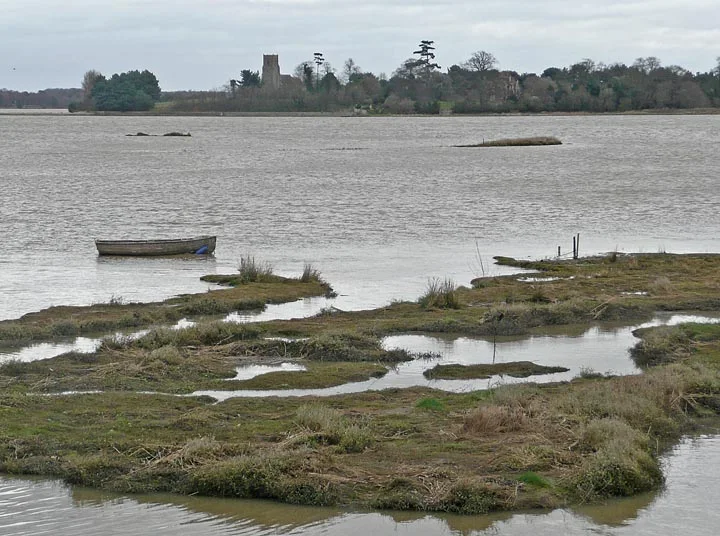
The mysterious Yarn Hill with its wooded crown, the place said to be infested with ghosts and marsh demons

Gallery

Below are a selection of images taken from from the photo album for this walk. Feel free to browse through these or click on an image to view a larger version in the Gallery.

Summary of Document Changes

Last Updated: 2021-12-07

2011-02-13 : Initial publication
2012-10-20 : added in more photos
2016-01-15 : General website updates
2019-01-09 : General website updates
2021-03-17 : Update website improvements and removal of ViewRanger reliance
2021-12-01 : Removal of ViewRanger links due to its imminent demise

Wednesday, 5 December 2018

The Orford Loop, Tales of Castles and Mermen

A 16 mile walk around the Orford Loop section of the Suffolk Coast Path

The main Suffolk Coast Path cuts through Tunstall Forest from Iken Cliff to Chillesford. However, more recently, a path has been added which allows access to Orford by following the Alde estuary. This then cuts back across Gedgrave marshes and Sudbourne Hall to return to the main path at Chillesford.

Orford Quay to High Street Walk - Essential Information

Walk Statistics:

  • Start location: Orford Quay 
  • Distance:   miles (  km)
  • Total Gain:   ft (  metre)
  • Total Descent:   ft (  metre)
  • Min Height:   ft (  metre)
  • Max Height:   ft (  metre)
  • Walk Time:  
  • Walk type: Circular
  • Walk Grade: Easy
  • Terrain: Footpaths and defence banks

Maps:

The following maps and services can assist in navigating this route. There are links to printed maps and links to downloadable GPX route data for importing into navigational software and apps.


Route Verification Details

  • Date of Walk: 2011-03-19
  • Walk Time: 10:00 to 17:00
  • Walkers: Griffmonster, Kat
  • Weather Conditions: Clear blue skies, bright sunshine with a fresh southerly breeze.

Walk Notes

This path is not shown on OS maps and there is little, if any, documentation about it. However, the route is clearly waymarked with the distinctive yellow and blue waymarkers though it does become a little confusing at Sudbourne Hall where you need to veer off to the right through a little wood. If this is missed, there is a track just beyond the Hall which meets back with the path as it heads across the fields. Another site that is confusing is at the little hamlet of High Street. There is a sharp right turn in the lane with no waymarker directing around this. We carried straight on, which took us down to the marshes. This connects up with the path along the river flood defences but on this occasion the meadows in front of the defences were flooded and we had to take off boots and socks to wade through them. The actual route continues along the lane where there is another track on the left. This provides a better drained route to the defences.

The going along the river defences can be a little telling on the feet. This ground is very hard and after several miles your feet know certainly about it. It was interesting to note a group of girls heading northwards along the defences. Not sure where they were heading for and with less than 2 hours of light left in the day it would take them this long just to get to the nearest civilisation at Iken. Maybe they were heading for some the makeshift structure we witnessed which was cobbled together out of debris and tree trunks complete with a fridge and appeared to be some makeshift isolated bar!

The River Alde by Sudbourne marhses

Directions

The majority of the path is clearly marked with the distinctive circular blue 'Suffolk Coast Path' way markers. From Orford Quay take the riverside path south to the Chantry Marshes. Just before Chantry Point the path descends from the river defences and cuts across the marsh to southerly side. Rejoin the river defences until the river bends where a track heads inland to small country lane. Turn right and continue up to Richmond Farm.

The official loop returns to Orford and then heads back out of the town north-westwards. An alternative is to take the sandy track opposite Richmond Farm up to Gedgrave Broom, then follow the tree boundary and continue until the Orford Loop crosses this track. Turn left and follow the track to Sudbourne Hall. At the far end of the large lawn beside the Hall there is a white footpath marker pointing to the right alongside a small wood. This will then lead through the trees on a path locally known as the Friars Path and continues across fields to join the B1084 at Chillesford. Here it joins the main Suffolk Coast Path.

The Froize pub is a few yards along the road from where a track heads up the hill to a group of cottages. At the cottages turn right and follow the track which turns left and heads up into Tunstall Forest. Keep to the main track through the forest, crossing over the B1078 and continue until it soon joins a broad track. When this broad track branches off to the left continue straight on along a smaller path which comes out at the edge of the forest on the B1084. Cross the road and follow the trees to the end of the field.

The main route turns left here but a short-cut through to Iken can be made by continuing straight on following the edge of a small wood and then down to a lane. As the footpath comes out onto the lane continue straight ahead until it comes to a T-junction at Iken. Turn right following the lane up the hill where some fantastic views can be had of Yarn Hill and the Alde estuary. When the lane turns a sharp right at High Street you can continue and a footpath will lead you down to the rivers edge - although the marshes here are liable to flooding which will involve taking shoes and socks off and wading! Alternatively you can follow the lane around to the right and take the next left turn. Keep to lane until it meets with the river. Return to Orford is now merely a case of following the River defences. Be wary of a waymarker pointing across a meadow as you head to the river turn at Slaughden. This path, as depicted on OS maps leads across the meadow and rejoins the river edge at the tip of the turn in the river - however, the footbridge across the ditch is no longer there, so keep to the River defences throughout.

The Jolly Sailor at Orford, welcomes children, dogs, horses and parrots and humans by appointment

Pubs

The Froize Inn, Chillesford View in OS Map | View in Google Map

Image of pub
Address
The Street, Chillesford
Website

Owned by locally born and bred Suffolk Chef David Grimwood this Inn has gained a reputation for his quality 'rustic' English and French food predominantly made from locally sourced food. The Froize has only been a public house since the 1970's, having originally been a pair of gamekeepers cottages. There is debate over the origin of the name of the Froize but it is likely that it derives from a medieval Suffolk word for a friar as the Inn is located on the Friars Walk which links Sudbourne Hall with Butley Priory. The distinctive Inn Sign features a mural of a friar. The Inn is very finely decorated and furnished but walkers are welcome and there are benches on the patio at the side of the building. This is a freehouse with Adnams ales on offer along with London Stout from the Meantime brewery.

Review

We arrived at the same time as guests from a wedding anniversary party which soon had the pub very busy. It is very smart establishment so, being walkers, we elected to sit outside on the patio. The staff were polite and attentive. I am not usually keen on drinking keg beers, but my interest was aroused by the Meantime Stout that was on offer. A very pleasing pint and nothing like Guinness.

The Jolly Sailor, Orford View in OS Map | View in Google Map

Image of pub
Address
Quay Street, Orford
Website

Charming 16th century pub on Quay Street in Orford offering freshly caught fish landed at Orford Quay and home smoked hams and hand made sausages and a full compliment of Adnams ales. An array of pastimes are available including dominoes and shove-ha’penny as well as newspapers and during winter months there is a roaring log fire. A sign outside the pub advertises 'Children, Dogs, Parrots and Horse are welcome, humans by appointment!' Legend has it that the pub was built from the timbers of wrecked ships and is said to have been a smugglers haunt. A 'wanted' poster for an escaped lady horsethief is displayed on the walls of the pub. This was a certain 18-year-old Margaret Catchpole whom was captured at the pub and subsequently transported to Australia. Accommodation available as well as a campsite amidst the orchard at the rear of the pub.

Flooded marshes at Iken

Features

The Orford Merman: View in OS Map | View in Google Map

A curious tale from that originates from the 12th century AD about Orford fisherman capturing a wild man of the sea in their nets

A curious Orford tale is that of the Orford Merman. The story was first recorded by Ralph of Coggeshall, an English chronicler and monk, who wrote the tale of the Wild Man of Orford, in the Chronicon Anglicanum in 1200, some years after the events. In this chronicle he states that in or around 1167 Orford fisherman caught a wildman in their nets. He was said to be naked and was 'like a man in all his members, covered with hair and with a long shaggy beard'. Local caricatures also depict him with a bald head. Attempts to communicate with him failed so the fishermen took him to the castle where the custodian, Bartholomew de Gladville, kept him prisoner. Many attempts were made to speak with the merman but the only response was a mixture of grunts and strange noises. Frustrated with the merman's lack of speech Bartholomew de Gladville ordered his torture by hanging him him upside down from his ankles. Even this did not reciprocate a response.

He was taken to church but shown no signs of a belief in God. He took to his bed at sunset and always remained there until sunrise. He would only eat fish and had the unusual habit of squeezing the water from raw fish and drinking it. Then one day the merman was taken down to the harbour where the fisherman had strung nets across the entrance, and he was allowed into the water. He immediately swam under the nets and headed out to sea, bobbing up and down as if teasing the onlookers on shore. Unexpectedly he returned a few days later to resume his life on land but then escaped a second time and swam off never to be seen again.

Who this merman was we will never know but it is reputed that his ghost still haunts the castle.

References

Orford Castle: View in OS Map | View in Google Map

A well preserved example of a polygonal towered castle

Prior to the building of the Castle, the area around Orford was dominated by the Bigod family who held the hereditary title of Earl of Norfolk and owned Framlingham Castle. Hugh Bigod, 1st Earl of Norfolk was one of a group of dissenting barons and King Henry wanted to regain his authority in the region. Henry drained the marshes and turned Orford into a sheltered port and built the castle and church between 1165 and 1173

In 1173, Henry's eldest son rebelled against him and was backed by a number of barons including Bigod and also a number of Flemish mercenaries who landed near Orford. Upon the collapse of the rebellion, Henry ordered the confiscation of Framlingham Castle. Orford Castle was not as important after Henry's death in 1189. The castle was captured by Prince Louis of France who invaded England in 1216 at the invitation of the English barons who were disillusioned by King John

In 1280 under the rule of Edward I Orford Castle was granted out and eventually sold. This marked the beginning of the end of Orford Castle, as the estuary of the River Alde silted up and trade declined, reducing the importance of the castle as the centre of local government. Orford was a borough from 1579 to 1886 with parliamentary representation between 1483 and its abolition under the Reform Act 1832. There was also an Earldom of Orford, the most notable of whom was Sir Robert Walpole, the first Prime Minister of Great Britain.

Today, Orford Castle is unique with its well preserved polygonal tower keep and is the earliest castle whose entire building accounts survive which are held in the Public Records Office in London. Inside there is a basement, lower and upper halls and access to the roof where there are magnificent views seaward to Orford Ness. Around the rooms is a maze of passages leading to the chapel, kitchen and other chambers in the turrets.

References
On the left is the distictive sign for the Froize Arms at Chillesford, on the right is Orford Castle.On the left is the distictive sign for the Froize Arms at Chillesford, on the right is Orford Castle.
On the left On the left is the distictive sign for the Froize Arms at Chillesford, on the right is Orford Castle.; On the right On the left is the distictive sign for the Froize Arms at Chillesford, on the right is Orford Castle.

Links and Bibliography:

Gallery

Below are a selection of images taken from from the photo album for this walk. Feel free to browse through these or click on an image to view a larger version in the Gallery.

Summary of Document Changes

Last Updated: 2021-12-07

2011-03-20 : initial publication
2018-12-05 : general website updates
2021-03-17 : Update website improvements and removal of ViewRanger reliance
2021-12-01 : Removal of ViewRanger links due to its imminent demise

Indexes and Info

East Suffolk PRoW Access

The Public Rights of Way (PRoW) within the Suffolk Coastal area between Aldeburgh and Southwold are subject to being blocked up and diverted due to the extensive industrial projects that are currently taking place in the area including the Sizewell C development and various wind farm projects. A PRoW Access page has been written to detail known issues in the area

Walk Summaries

Latest walk summaries are basic information sheets for walks that have yet to be fully documented. These provide links to maps, public transport and walks stats, although detailed notes and features are not included.

Latest Walk Summaries

Featured Walk

In Search of Sizewell Chapel

A 10 mile walk following the southern side of the parish boundary of Leiston in Suffolk This walk follows the route of a 17th century peramb...

What is GPX

All you need to know about GPX, electronic mapping and how to use modern apps and mobile devices as navigation devices

Popular Walks

Maps

Diary of a Suffolk Common

The ramblings and musing of the Griffmonster