Route details, maps, pubs, features, local history and folklore for a wide variety of walks focusing primarily on Norfolk and Suffolk

find_in_page

Keyword Search Results

Walks

The Sandlings Walk - Bromeswell to Snape

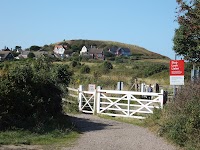
Wantisden church

A 16 mile walk along the Suffolk Sandlings Path between Bromeswell and Snape taking in Rendlesham and Tunstall forests

The route leads across gorse covered heathland and through forest which typifies the modern landscape of the Sandlings. The forests are a modern development, set up with the founding of Forestry Commission during the 1920's to provide Britain with a sustainable source of timber. One cannot fail to notice the twin airbases of Woodbridge and Bentwaters, the scene of a infamous military encounter with a UFO during December 1980.

Walk Statistics

  • Start location: Bromeswell 
  • End location: Snape Maltings 
  • Distance:   miles (  km)
  • Total Gain:   ft (  metre)
  • Total Descent:   ft (  metre)
  • Min Height:   ft (  metre)
  • Max Height:   ft (  metre)
  • Est. Walk Time:  
  • Walk type: Linear
  • Walk Grade: Easy
  • Terrain:

Maps

The following maps and services can assist in navigating this route. There are links to printed maps and links to downloadable GPX route data for importing into navigational software and apps.


Transport

Service
Service Details
Unfortunately there is no longer a regular bus service that serves Snape Maltings therefore there is no public transport to connect the two ends of this walk. The nearest bus service by continuing along the Sandlings path would be Friston, but this would involve a change at Saxmundham. At the other end, the 800 service links Bromeswell, Melton and Woodbridge but is not very regular so it is beneficial to start the walk from Melton. It is always worth using the Traveline website in case any service becomes available
Timetable

View in OS Map | View in Google Map

Image of pub
Address
Woodbridge Rd, Butley
Website

This village inn dates back to 12th Century and still retains many old features such as oak beams, and a cast iron fire surround which allegedly dates from the 1700's and the walls are adorned with local photos and articles. Tax records show that the pub was known as The Great Oyster in 1617

After over four years of closure the pub reopened in March 2017 and is a charming, warm, rustic old pub, unspoilt by the rigours of age. The owners added an on-site shop and a microbrewery but despite this in 2019 the pub once again closed its doors. The future is currently uncertain with possible change of ownership or purchase by the local community.

Review (2010-04-03)

Adnams ales on offer, a roaring fire to sit in front of and some old locals telling us about the history of the old inn. Perfect.

Plough and Sail, Snape View in OS Map | View in Google Map

Image of pub
Address
Snape Maltings, Snape
Website

There has been a pub here since the 16th century, when it was a smugglers inn at the head of navigation on the River Alde. Throughout this period and right up until 1965 the pub was also the focus for the sailors who traded barley on the Thames Barges that berthed on the quayside.

The pub was taken over in April 2012 by twin brothers Alex and Oliver Burnside. They offer quality seasonal food produced from local suppliers as well as local ales. There is a spacious restaurant, a cosy bar and intimate balcomny area. Seating is provided in front of the pub and there is a courtyard at the back.

Review (2010-04-03)

A final pint of Adams Explorer before the bus home. Although the air was cool it was still warm enough to sit on the bench outside and reflect on the great days walk.

Features

Gobblecock CottageView in OS Map | View in Google Map

This somewhat amusing name is probably derived from the old Suffolk name for a turkey-cock which was known as a gobble-cock and could reflect the keeping of turkeys in days gone by. This 19th century rubble flint thatched cottage is a grade II listed building. This cottage is the sole surviving intact example of a gamekeeper's cottage on this shooting estate.

The Sandlings ForestsView in OS Map | View in Google Map

The area of East Suffolk known as The Sandlings is characterised by extensive unfertile sandy soils. This is the domain of hardy plants that can survive this habitat: gorse, bracken and heather are abundant throughout this area.

The first world war brought realisation of how much timber was imported into this country and after hostilities ceased The Forestry Commission was set up to provide a home grown timber resource. Naturally the farmers and landowners from the Sandlings area were eager to sell their poor quality land to this new organisation and thus in 1921 the forests were set up at Rendlesham, Tunstall and Dunwich.

The combined forests cover about 8648 acres of the former Sandlings. The great storm of 1987 devastated much of Rendlesham forest with over a million trees being blown down. Since then the forest has been replanted with a more varied mix of trees to include both conifer and broadleaved varieties intersected with clearings, wetland and heath to provide a varied habitat that encourages wildlife and fauna.

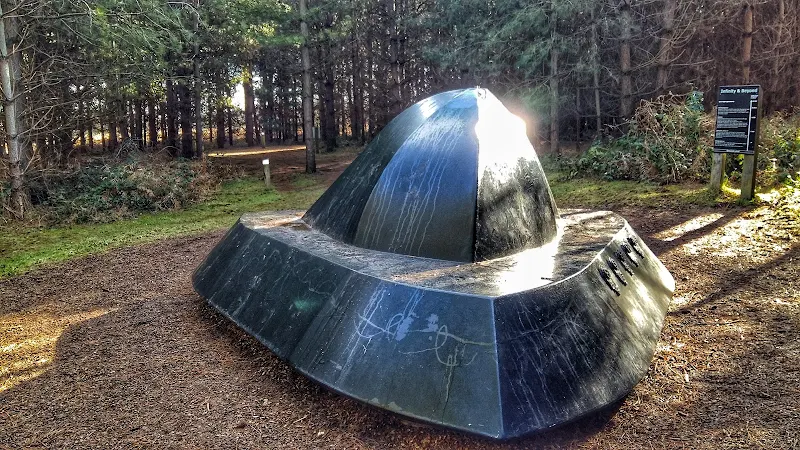
Each forest area has public access. Rendlesham Forest has been enhanced with cycle and walking trails including the UFO Trail to commemorate the landing and encounter with a UFO by USAF Servicemen in 1980. Sometimes referred to as The British Roswell, this event happened over several days of the Christmas period of 1980 and witnessed by dozens of military servicemen as well as civilians. The UFO Trail navigates from The East Gate of RAF Woodbridge, where the UFO was initially witnessed landing in the forest, and leads through the forest on the alleged route the servicemen travelled to where they found the unknown craft landed, and which is now marked by a sculpture. Full details of a walk incorporating this trail can be found at An Extended Walk around the Rendlesham UFO Trail.

The forest also includes activity areas and regularly hosts events including Theatre in the Forest. A camping area provides access for those who want to stay over in these delightful surroundings.

Staverton ParkView in OS Map | View in Google Map

The area north of RAF Woodbridge, to the east of Rendlesham forest is known as Staverton Park. It is thought that this was originally a deer park created between the 11th and 13th centuries. Records show that during this time that the abundant oak was used in a wide variety of manners. This included bark for tanning leather, acorns for pig feed as well as the usual timber and fuel.

Later, during the 16th century the oaks started to be pollarded which was done on a 50 year cycle. During this period there was also Staverton Hall located to the south west of the present woodland in what is now Rendlesham Forest

Today the site, described in 1986 as 'a famous and awesome place of Tolkienesque wonder and beauty' is a Special Area for Conservation (SAC) and a Site of Special Scientific Interest (SSSI). The ancient woodland consists of oak and birch with some holly trees which are said to be the largest in Britain. It has an awesome woodland of ancient oak and birch, and part of the site has holly trees reputed to be the largest in the UK. It may have been a deer park in the Middle Ages and there is a fenced-off area for these mammals now. Privately managed.

Wantisden ChurchView in OS Map | View in Google Map

Wantisden church, dedicated to John the Baptist, can be found on the track that leads around the eastern perimeter of RAF Bentwaters. There is no road access to this remote church and up until the 1950's it was positioned within the enclosure of the military area. This necessitated a military escort for those who wanted to visit the church.

The significant feature of the church is the coralline crag tower of which there are only two examples in the county, the other being at nearby Chillesford. The tower dates from the 15th century and is curious by the fact that it has no battlements.

Route Validation Cards

Validation Date - 2010-04-03

  • Time of Walk: 09:30 to 16:00
  • Validators: Griffmonster, Kat
  • Weather Conditions: Cool but bright. Odd threat of a shower but nothing eventually occurring
  • Notes: Initial route undertaken

Validation Date - 2014-12-19

  • Time of Walk: 07:00 - 14:00
  • Validators: Griff
  • Conditions: Clear day after previous days rain
  • Notes: As ever, I got a little lost in Rendlesham Forest
Summary of Document Changes

Last Updated: 2026-01-12

  • 2021-03-17 : Update website improvements and removal of ViewRanger reliance
  • 2021-12-01 : Removal of ViewRanger links due to its imminent demise

An Extended Walk around the Rendlesham UFO Trail

A 12 mile circular walk starting at Eyke and incorporating the UFO Trail in Suffolk's Rendlesham Forest

The Rendlesham UFO trail is a waymarked 3 mile trail around the eastern end of Rendlesham Forest that navigates around the key areas that were involved in the Rendlesham Forest Incident of 1980 in which both civilian and military personnel witnessed unexplained craft land within the forest. Although this can be walked by parking up at the visitor car-park in the forest, a longer alternative is to take the footpaths from Eyke, and make a day of this most wonderful and intriguing part of Suffolk.

Rendlesham Forest and Butley Walk Summary

Salt marsh

A woodland walk, a UFO encounter, quiet country lanes and a good old country pub

This is a great way to spend a day exploring. Rendlesham forest has many trails created by the Forestry Commission in order to discover this working forest. However this trail goes off piste to discover a little more. The first notable thing of the walk is the runway close to the car park. Although now redundant, this was a RAF air base that was taken over by the USAF and was a key hub during the Cold War. The forest surrounding the base is renowned as the location of a UFO encounter by US military that occurred during December 1980 and the Forestry Commission have a trail dedicated to this. The first part of this route heads out along this trail to view the UFO sculpture that depicts the craft encountered at one of the alleged landing sites. Some claim that the forest is still subject to strange unearthly occurrences so tread carefully!

The route heads out to view the curious sculpture which substitutes as the village sign for the village of Capel St Andrew. This iron man was commissioned at the millennium and created by local sculptor Paul Richardson. It is said to represent St Andrew as a fisherman, with his left hand clutching an eel whilst his right holds a fish. He is surrounded by oak trees that once covered this landscape and at his feet is a chapel from which the word capel is derived.

The walk also pays a visit to the ruins of Butley Abbey which dates from the 12th century. All that is left is a tall arch from the original church building which is now hidden away within a group of farm buildings. Further north is the impressive building of Butley Priory which was originally a 14th century gatehouse to the abbey. These days it is renovated and used as a wedding venue.

More information on the UFO encounter can be found at An Extended Walk around the Rendlesham UFO Trail.

The Sandlings Walk

The Sandlings Waymarker

An overview of the Sandlings Walk, a 55 mile long distance path through the forests and heaths of East Suffolk

The Sandlings is a 55 mile walk starting at Rushmere Heath on the eastern side of Ipswich with Southwold, passing through the remaining fragments of East Suffolks Sandling Heaths. The trail leads through Rendlesham, Tunstall and Dunwich forests and also includes riverside walks at Woodbridge and heathland walks across Rushmere Heath, Sutton Heath, Thorpeness Common and Dunwich Heath..

diversity_3

Popular Walks